Table of Contents
I’ve had at least a dozen clients walk into my chair this year holding up a screenshot of Billie Eilish or Lady Gaga and asking for “that weird jellyfish thing.” And every single time, they’re a little nervous. Because here’s the truth: most of what’s written about this cut online either oversells it as “edgy and bold!” without telling you anything useful, or it reads like a technical cutting manual meant for other stylists, not for the person actually sitting in the chair.
So let me actually walk you through it, the way I would if you were sitting in my salon right now. What the jellyfish haircut really is, why half of Gen Z suddenly wants one, which version will actually suit your face and hair type, how to style it yourself on a lazy Tuesday morning, and the exact sentence to say to your stylist so you don’t end up crying in the car afterward.
What Is the Jellyfish Haircut, Really?
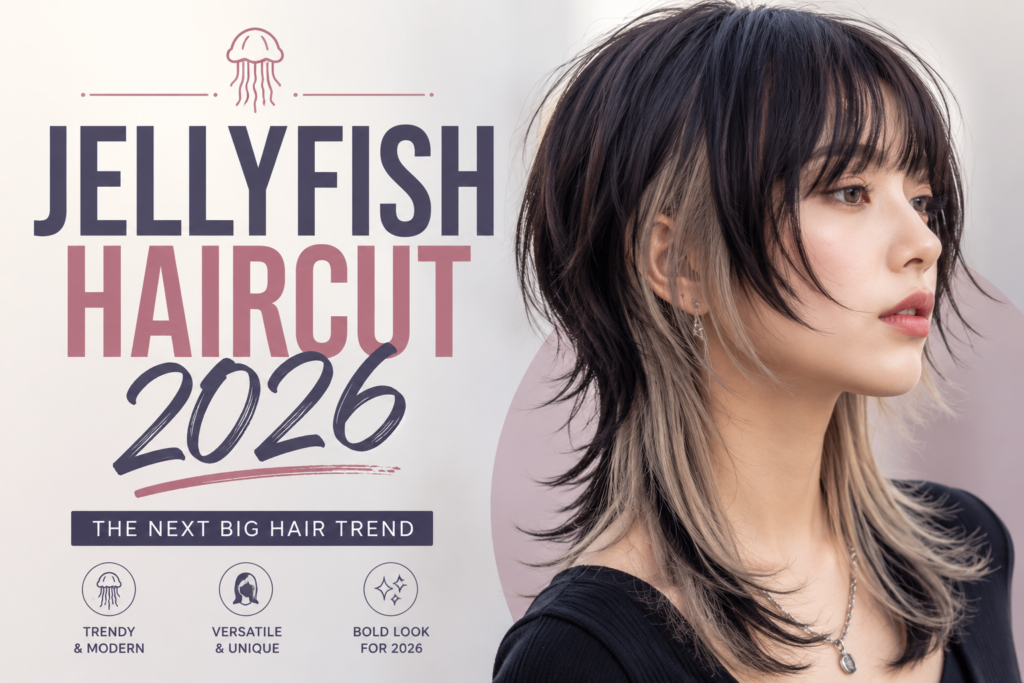
Strip away the ocean metaphor for a second. A jellyfish haircut is, structurally, a two-tier cut with a hard, visible break between the sections instead of a soft blend.
The top section, what most of us in the industry just call “the bell,” is a short, structured layer cut into something like a bob, a bowl shape, or a cropped silhouette. It sits close to the head and ends anywhere from ear level to the chin. Then underneath it, completely disconnected, are the “tentacles”: long strands that are left to fall freely with zero blending into the top.
That disconnection is the entire point. There’s no soft graduation, no gentle feathering between the two lengths. It’s short on top, dropping straight into long underneath, with an obvious visual line where one ends and the other begins. On the right face, that tension between structure and flow is what makes this style look genuinely striking instead of just messy.
A quick note before we go further: yes, this cut has real roots. It borrows heavily from the Japanese Hime cut of the Heian period (short, blunt panels framing the face with longer length at the back), and it shares some DNA with the mullet’s “short in front, long in back” logic, just applied top-to-bottom instead of front-to-back. It made its way through Korean salon culture and anime-inspired styling before TikTok ever got hold of it.
Why Everyone Is Suddenly Talking About the Jellyfish Haircut in 2026
If you’ve felt like this cut came out of nowhere, you’re not wrong; it had a very specific moment. At the 2025 Grammys, Lady Gaga, Miley Cyrus, and Billie Eilish all showed up wearing some version of this exact structure, and none of them looked alike.
Cyrus leaned Y2K with chunky blonde pieces. Gaga went full futuristic with jet-black hair, micro bangs, and bleached brows. Eilish, true to form, wore hers low-key, tucked under a baseball cap in a loose ponytail. Three completely different women, three completely different moods, one underlying cut. That’s what made stylists like me start getting flooded with requests almost overnight, and it’s genuinely one of the more versatile viral cuts I’ve seen come through in a while.
There’s a cultural piece here too, and I think it matters. Gen Z, in my chair at least, keeps telling me they’re tired of hair that blends in. A cut that refuses to look “normal” reads as a small act of individuality, and that’s a big part of why it has stuck around instead of fading after one red carpet cycle.
Jellyfish Haircut vs. Wolf Cut vs. Butterfly Cut
Clients confuse these three constantly, so let me settle it once and for all.
| Feature | Jellyfish Cut | Wolf Cut | Butterfly Cut |
| Structure | Two completely disconnected tiers | Blended layers throughout | Layered, face-framing |
| Top section | Short, rounded, bob or bowl shape | Shorter, shaggy crown | Crown layers, longer overall |
| Contrast | High, intentional disconnection | Low, seamless blend | Medium, soft graduation |
| Vibe | Avant-garde, editorial, bold | 70s rock, effortless | Romantic, feminine |
| Maintenance | Every 4 to 6 weeks | Every 6 to 8 weeks | Every 6 to 8 weeks |
| Known for | Billie Eilish, Lady Gaga | Miley Cyrus (earlier era) | Florence Pugh |
My rule of thumb when someone’s deciding between the three: if you want something dramatic and fashion-forward, go jellyfish. If you want edgy that grows out gracefully with less upkeep, go wolf cut. If you want something soft and romantic, the butterfly cut is your answer.
Jellyfish Haircut for Women:

This is where I want to slow down, because this cut isn’t really one haircut. It’s a framework, and I cut it differently depending on what walks through my door.
1. The Classic Jellyfish (Maximum Contrast)
This is the Gaga version. A clean, blunt bob on top ending around the chin, and a bottom section left completely disconnected and untouched. No feathering, no blending. I only recommend this to clients who are genuinely ready for the drama, because it does not hide in a crowd.
Best for: straight hair, bold personalities, anyone who wants to make a statement.
2. The Layered Jellyfish Cut
This is what I put about seventy percent of my jellyfish clients into. Instead of a hard line, we add interior layering and texture so the two tiers are still visible, but the edges are softened. You still get that signature two-level shape, just with more movement and a lot more wearability for everyday life, including the office.
Best for: people nervous about commitment, wavy hair, anyone who needs it to work Monday to Friday.
3. The Short Jellyfish Cut
Here the top bob sits higher, right at or above the ear, and the bottom layer stops at or just below the shoulder. It’s a smaller version of the drama, easier to manage, and a great starting point if you’re not ready to commit to serious length underneath.
4. The Curly Jellyfish Cut

Honestly? This might be my favorite version to cut. On curly hair, the top section builds into this gorgeous, naturally rounded bell shape, and the bottom tentacles get bounce and life instead of just hanging flat. I had a client with 3B curls last spring who almost talked herself out of it, and now she messages me every few months asking me not to “blend it out” during trims. The one non-negotiable: proper interior layering in the bottom section, or thick curly hair will look heavy instead of flowing.
Best for: type 2B to 3B curls, anyone wanting texture and warmth without losing the structure.
5. The Long Jellyfish Cut
Top stays short, but the tentacles run all the way down the back, sometimes to the waist. This is the most dramatic silhouette of the bunch, and it’s the version I see most on editorial shoots and K-beauty inspiration boards. Straight or gently wavy hair shows off that length the best.
6. The Jellyfish Bob
Both tiers stay short here, top around chin level, bottom just an inch or two below. It’s really just a suggestion of the two-tier concept rather than a full statement, which makes it the safest entry point for more conservative workplaces.
Jellyfish Haircut for Men

Men ask for this more than you’d think, and I don’t blame them. The male version typically features a cropped, textured top, often faded at the sides, paired with longer sections left at the back, sometimes as distinct curtain pieces, sometimes as flowing layers underneath the crown.
Undercut Jellyfish:
Short, faded sides with a longer section left flowing at the crown and back. Clean enough to pass in most workplaces.
Bowl-Top Jellyfish:
A clean bowl shape on top with longer curtain-like lengths at the sides and back. This is the most gender-neutral take on the whole trend.
Mullet-Jellyfish Hybrid:
Short front and sides, a longer structured crown, and dramatic flow at the back. Very rock and roll.
If you’re booking this in, tell your stylist: “I want a two-tier jellyfish cut, short and structured on top, possibly faded at the sides, with longer length flowing underneath at the back. I want the contrast visible, but still wearable day to day.”
Which Jellyfish Haircut Suits Your Face Shape?

I get asked this constantly, so here’s my honest, face-by-face breakdown.
Oval face:
You can wear pretty much any version with confidence. Balanced proportions mean the drama never looks out of place. Go bold if you want to.
Round face:
Keep volume on top directed upward, not outward, and make sure the bottom tentacles have enough length to visually elongate things. Tell your stylist: “I have a round face, I want height on top, not width, and longer layers underneath to elongate my face.”
Square face:
Keep the top section soft rather than blunt, and add face-framing pieces to soften the jawline instead of echoing those angles. Say: “I have a square jaw; I want the layers to soften it, with face-framing pieces and a soft top rather than a blunt one.”
Heart face:

The natural face-framing of this cut works beautifully here. Let the bottom tentacles add width around the chin to balance a narrower jawline.
Diamond face:
The crown volume built into this cut balances a narrower forehead nicely, and the flowing bottom layers soften strong cheekbones. Adding bangs helps bring the whole look into proportion.
How to Style the Jellyfish Haircut at Home, Step by Step
Once you leave the salon, styling this yourself is genuinely simpler than the finished look suggests. Here’s exactly what I tell my clients to do.
What you’ll need: volumizing mousse, a round brush, a blow dryer, a flat iron or 1-inch curling wand, texturizing spray, light hairspray, and shine serum if you want it.
Step 1: Prep.
Towel-dry until your hair is about 80 percent damp. Apply mousse to the roots and crown only; leave the bottom tentacle section product-free for now.
Step 2: Shape the top.
Using a round brush, blow-dry the top section in a rounded, downward-curving motion, section by section from the crown out, building that dome shape.
Step 3: Set the top.
For a sleek finish, run a flat iron through in smooth passes. For a more textured, casual jellyfish, skip the iron and separate the top with your fingers, then spritz texturizing spray through it.
Step 4: Style the tentacles.
This is the fun part. Use a wand or flat iron to add bend or wave to the bottom section, then a light dry texture spray for separation. Straight hair: flat iron root to tip and add a touch of shine serum. Wavy, wrap around a 1-inch wand for eight seconds and release. Curly, scrunch curl cream through damp hair and diffuse on low heat; never brush it out.
Step 5: Create the contrast.
Once both sections are styled, tuck the bottom layers inward at the hairline for a second, then let them drop. It sounds small, but it’s what visually sells the whole two-tier effect.
Step 6: Set it.
A light mist of hairspray over everything, with a slightly stronger hold on the top section to keep the dome shape through the day. Ten to fifteen minutes total, start to finish.
Products I Actually Recommend for the Jellyfish Cut
You genuinely need two different product categories here: structure products for the top, flow products for the bottom, and that split is the real secret to this cut looking intentional rather than accidental.
For the top (structure and volume):
A volumizing mousse, a round brush, a flat iron if you want it sleek, and a medium-hold hairspray to lock the dome shape in place.
For the tentacles (flow and texture):
Sea salt or texturizing spray, curl-defining cream if you’ve got waves or curls, a shine serum for sleek ends, and a diffuser or curling wand for movement.
On color: if you want to really lean into the visual separation, ask about two-tone techniques, pastel roots fading into a fashion color, or platinum paired with jet black. If that’s too much commitment, even a single balayage or face-framing highlight will contrast tiers noticeably more visibly.
What to Actually Say to Your Stylist
Bring photos, always. Two or three reference images will save you more back-and-forth than any paragraph of description. But if you want the words too, here’s exactly what to say:
For the classic jellyfish: “I want a jellyfish cut. Keep the top a short, blunt bob around chin or ear length. Leave the bottom long and completely disconnected, like tentacles. I don’t want it blended; I want the contrast obvious.”
For the layered version: “I want a jellyfish-inspired cut, but softer, with feathered edges instead of a hard line. Two visible tiers, but with movement.”
For curly hair: “I have curly hair and want a jellyfish cut. Keep the top a rounded bob shape, but layer the inside of the bottom section well so it doesn’t look heavy.”
The Honest Truth About Jellyfish Haircut Maintenance
I won’t sugarcoat this one. With trims every 4 to 6 weeks to maintain the top layer’s shape, the jellyfish haircut can hold its structure for several months. Skip those trims and the shorter layers start blending into the longer ones, and the whole point of the cut quietly disappears.
Daily upkeep is light, maybe 10 to 15 minutes, mostly focused on that top section since it needs the blow-dry to hold its shape. The bottom tentacles are genuinely low-maintenance. If you’ve gone two-tone with color, plan on touch-ups every 4 to 6 weeks as well.
Growing it out gets a little awkward around the 8 to 12 week mark, right when the top starts losing definition, and the two tiers begin to blend into each other. When my clients hit that point, I usually soften the whole thing into a layered wolf cut or shag, which tends to transition out beautifully instead of looking like an accident.
Mistakes I See Clients Make With This Cut
A few things I wish more people knew before they book this in, learned the hard way over a lot of consultations.
Skipping the trims.
I mentioned this above, but it’s worth repeating on its own. The entire shape lives or dies on that top section holding its line. Push your trim past 6 weeks, and you’ll watch the two tiers slowly merge into something closer to a generic long layered cut, not a bad look, just not the one you asked for.
Going in without reference photos.
“Jellyfish” means five different things depending on which stylist you ask. I’ve had clients describe what they wanted verbally, and what I pictured versus what they pictured were two different haircuts entirely. Bring photos. Every time.
Not accounting for hair density.
Very thick, coily hair needs a heavier hand with interior layering in the bottom section, or the tentacles end up looking like a solid block instead of moving pieces. If your stylist doesn’t ask about your hair’s density and texture before cutting, that’s worth flagging.
Styling both sections the same way.
This is the one that trips people up most at home. If you blow-dry the whole head the same way, top and bottom, you lose the entire visual point of the cut. The top needs volume and structure, the bottom needs movement and looseness. Treat them as two separate styling jobs, because that’s what they are.
Try It Before You Commit
If you’re still on the fence, cutehairstyles.org has a free AI hairstyle simulator where you can upload a photo and preview the jellyfish cut, and a bunch of other styles, on your actual face before you sit in a stylist’s chair. No registration, no card, just a quick way to see the contrast on your own features before you commit to it.
Frequently Asked Questions
What is the jellyfish haircut?
It’s a two-tiered hairstyle with a short, structured top layer, similar to a bob or bowl cut, and long, disconnected hair left underneath. The two sections aren’t blended; that visible break is what creates the jellyfish’s signature bell-and-tentacle silhouette.
What is Billie Eilish’s haircut called?
Her choppy, two-tiered cut debuted just before the 2025 Grammys and is a jellyfish cut, styled in her usual understated way: a short, slightly dishevelled top with longer pieces underneath, worn low-key rather than performative.
What is the Gen Z haircut called?
Gen Z has embraced quite a few cuts: the wolf cut, the butterfly cut, the bixie, but this cut has become one of the defining Gen Z styles of 2024 through 2026 thanks to its adoption by artists like Billie Eilish and Doja Cat.
What are Gen Z hairstyles?
Beyond the jellyfish, the current Gen Z rotation includes the wolf cut (shaggy, blended layers), the bixie (a bob-pixie hybrid), and curtain bang shags, all of which share that same lived-in, deliberately imperfect energy.
Is the jellyfish haircut good for fine hair?
Yes. Fine hair actually shows the separation between tiers more crisply, since there’s less bulk to blur the line. Blow-dry the top with volumizing mousse for lift, and keep the bottom section sleek so it doesn’t read as thin.
How often do you need to trim a jellyfish cut?
Every 4 to 6 weeks if you want the sharp contrast to hold. A more relaxed, blended version can stretch longer between trims without losing its shape.
Is the jellyfish cut suitable for all hair types?
Yes, straight, wavy, and curly hair all work; you’re just adjusting the internal layering to suit the texture. Straight hair shows the cleanest contrast, wavy adds movement, curly needs the most attention to interior layering so the bottom doesn’t get heavy.
What does the jellyfish haircut actually mean or symbolize?
There’s no deep symbolism here beyond what it visually represents: structure on top, freedom underneath. Most of my clients who choose it are drawn to that same idea for themselves: something disciplined and intentional paired with something loose and expressive. It’s become shorthand in Gen Z circles for embracing individuality over a uniform, blended-in look.
What is Selena Gomez’s short haircut called?
Selena Gomez has worn a short, layered bob with face-framing pieces that’s often described as a jellyfish bob or a jellyfish-inspired cut. Hers sits on the softer, more blended end of the spectrum, with a chin-length top and slightly longer layers underneath, rather than the dramatic disconnection of the full version. It’s a good entry point if you like the concept but want something feminine and easy to wear daily.
Final Thoughts
If you’ve read this far, you’re probably not looking for permission to try something safe; you already know that. What I’ll say after cutting this shape more times than I can count is that the jellyfish haircut rewards people who commit to it properly: regular trims, two different styling routines for top and bottom, and a stylist who actually asks about your hair’s density before picking up the scissors.
It’s not the lowest-maintenance cut out there, and it’s not meant to be invisible. That’s the whole appeal. If you want a haircut that looks deliberate rather than default, and you’re willing to put in ten minutes with a round brush most mornings, this is one of the more rewarding trends I’ve cut in years. If you’re still unsure which version fits you, that’s exactly what a proper consultation, or the AI simulator above, is for. Either way, bring photos, be honest about your hair type, and don’t let anyone blend the two tiers “just to be safe.” That’s the one thing that actually ruins it.