
Table of Contents
A dad brought his teenage son in a few weeks back, and the kid pulled out his phone to show me a reference photo. The dad took one look and actually laughed out loud. “I had that exact haircut in 1996,” he said. “Didn’t think I’d ever see it on my own son.” That’s the curtain haircut in a nutshell, one of the only styles I’ve genuinely cut on a father, and then years later, cut almost the same way on his kid.
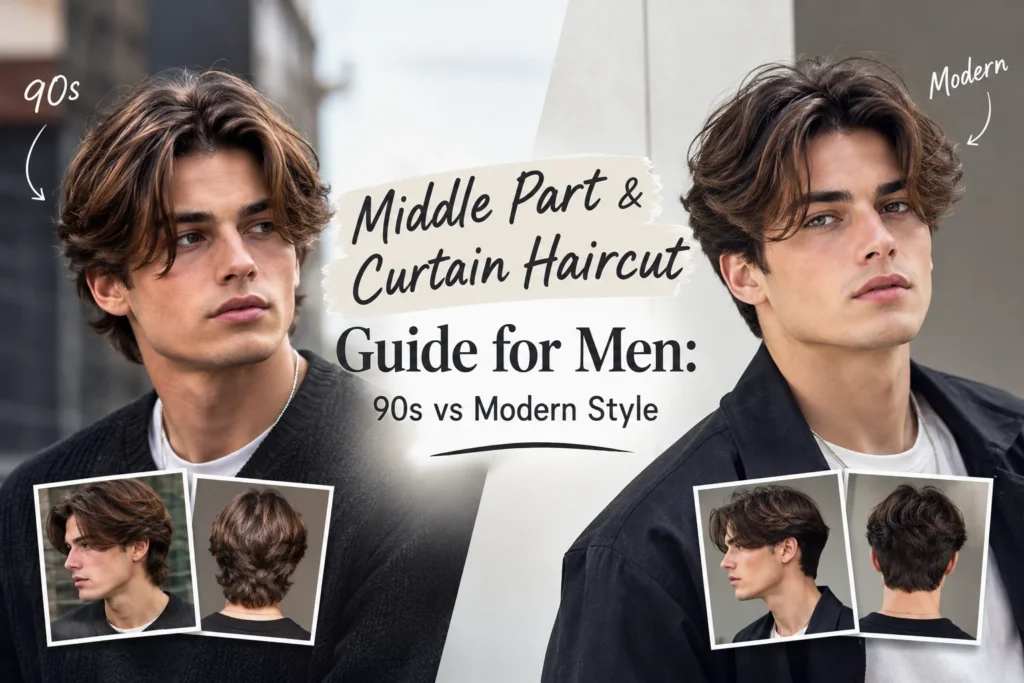
The curtain haircut has had a weird ride. Massive in the 90s, basically nowhere for most of the 2000s and 2010s, and now it’s everywhere again thanks to K-pop, TikTok, and guys who are just tired of the same fade everyone else has. But here’s what trips people up: the version coming back now isn’t a carbon copy of the 90s one, and mixing the two up is exactly how you end up disappointed walking out of the chair.
So let’s actually sort it out. What separates the original from the curtain hairstyle men are asking for today, the variations worth knowing, what to actually say to your barber, and how to keep it looking right once you leave the salon.
What Is a Curtain Haircut, Exactly?
At its core, a curtain haircut is a middle part haircut with longer length on top that’s parted down the center and swept to either side, framing the face like, well, curtains. The sides and back are usually kept shorter or faded, which pushes all the attention toward the fringe doing the actual parting work up top.
It’s not the same thing as just any middle part hair men might try. A curtain cut specifically needs enough length and the right texture on top for the part to fall naturally to each side rather than sitting flat or sticking straight up down the middle.
90s Curtain Haircut vs Modern Curtains: What Actually Changed
The 90s curtain haircut — think peak boy-band era — was all about length and volume. Sides were usually left fairly long too, not faded, and the whole thing had a soft, almost feathered finish with minimal product. It read as effortless because, frankly, it mostly was.
The modern curtain hairstyle men get today keeps the center-parted fringe but almost always pairs it with short, faded, or tightly tapered sides for way more contrast. There’s more intentional texture on top instead of that soft 90s feathering, and styling tends to be a bit more deliberate — a little product, a blow-dry, some shape to it rather than letting it just sit there.
If you’re bringing in a photo, be specific about which era you mean. “Curtain cut” alone can mean two genuinely different haircuts depending on who you’re talking to.
7 Curtain Haircut & Middle Part Variations to Know
1. Classic 90s Curtain Haircut
Longer on top and the sides, soft feathered part, minimal fade if any. This is the boy-band original, and it still works if you want something low-contrast and easygoing rather than sharp.
2. Modern Curtain Haircut With Fade
Center part up top, tight fade or taper on the sides. This is probably the single most requested version of curtain haircut I see right now; it keeps the nostalgic middle part but updates everything else around it.
3. Textured Curtain Haircut
Heavier point-cutting and layering through the top gives this version more texture and movement than the classic smooth curtain cut, so it looks more lived-in and less combed-down.
4. Curtain Haircut With a Mullet Back
Pairs the center-parted fringe with longer length left at the back. A bit more of a statement style, and one that genuinely surprises people with how well it works once it’s actually cut.
5. Long Curtain Haircut
More length on top overall, past the eyebrows, with a dramatic sweep to each side. Needs healthy, reasonably straight or loosely wavy hair to really hold that shape without looking messy.
6. Short Curtain Hairstyle Men With Less Commitment Want
A shorter take that still shows a visible part and that signature framing, but without the longer length some guys aren’t ready to grow out. Easier to maintain and a good entry point if you’re not sure the full curtain cut is for you yet.
7. Asian Middle Part Curtain Cut
A popular variation especially associated with K-pop styling, an asian middle part paired with soft, airy texture on top and usually a clean, tapered side. Tends to lean lighter and more tousled than the Western 90s version.
What to Tell Your Barber for a Curtain Cut
Naming the style is only half the battle. Here’s what actually gets the right result:
- Specify which era you want — 90s soft and long, or modern with faded sides. These are genuinely different haircuts.
- Say how much length you want left on top for the part. A curtain haircut generally needs at least 3 to 4 inches to actually fall and frame properly.
- Ask for the fringe to be cut with enough weight to fall center rather than sticking straight out — your barber needs to know this is a middle part haircut, not just a longer cut with no clear part.
- Mention your natural part if you have one. Cutting with your hair’s natural fall makes daily styling significantly easier.
- Bring a reference photo, but describe the sides too — fade height, taper, or kept long — since the top alone doesn’t tell your barber the whole picture.
How to Style Curtains Male Clients Ask Me About Most
- Towel or air-dry to about 80%, then apply a lightweight cream or light-hold paste; heavy product weighs the part down and kills the movement.
- Use a comb or your fingers to create the center part while hair is still slightly damp, pushing each side outward rather than down.
- Blow-dry with a round brush for more volume and a cleaner sweep, or just air-dry for a softer, more natural 90s-style finish.
- Don’t overbrush once it’s dry — this is one style where touching it up too much actually flattens the texture you want.
- Book a trim every 3 to 5 weeks. The part relies on length staying consistent, so letting it grow out unevenly throws the whole shape off.
Healthy, well-conditioned hair holds a part far better than dry or damaged strands. Our best shampoo for hair health guide has picks that keep hair manageable enough to actually style this way.
Does a Curtain Haircut Suit Everyone?
It’s genuinely more face-shape dependent than a lot of other current cuts, mostly because the center part draws a vertical line straight down the middle of your face.
- Oval and heart-shaped faces tend to handle a curtain cut the best, since the part doesn’t compete with existing proportions.
- Round faces can wear it, but usually look better with a deeper side-leaning part rather than a dead-center one, to avoid widening the face visually.
- Square faces suit the modern faded version especially well, since the sharp sides balance the softness on top.
- Straight or loosely wavy hair holds the part most reliably. Very curly or coily hair can still wear a curtain-inspired style, but usually needs more product and a modified version of the part to hold shape.
Not sure how it’d actually look on you? Our free AI Hairstyle Simulator lets you upload a selfie and preview a curtain cut before committing to anything at the salon.
For more reference looks, our celebrity hair inspiration roundup has plenty of curtain and middle part examples worth bringing in.
Curtain Haircut vs Other Middle Part Styles
Not every middle part haircut is technically a curtain cut. A basic middle part with shorter, straighter length that doesn’t sweep outward is just a center part — it’s missing the framing effect that makes curtains, curtains. If you want the actual curtain look, length and a soft outward sweep on both sides are non-negotiable, not optional extras.
If you’re coming from a shorter style like a crew cut or a low taper fade, know that growing into a proper curtain cut takes patience, usually a few months of growing out the top while keeping the sides maintained.
Growing Out a Curtain Haircut: What to Expect
If you’re coming from a short cut and chasing the full curtain look, the first six to eight weeks are the awkward part: hair’s too long to style short but not long enough to part and sweep properly yet. Keep the sides trimmed during this stretch so the growth stays controlled, even if the top looks a little shapeless for a while.
Most guys get enough length for a real middle part hair men can actually style around the three-month mark, depending on how fast your hair grows. A light leave-in product during this phase helps train the part to fall in one direction instead of fighting you every morning.
Ready to Try a Curtain Cut?
Bring this guide to your next appointment, point to the variation you want, and be clear about length and sides. That’s genuinely the difference between a curtain haircut you love and one you’re growing out again in a month.
For more cuts, styling breakdowns, and guides like this one, head over to CuteHairstyles.org — we’re always adding fresh content to help you know exactly what to ask for before you sit in the chair.
Frequently Asked Questions
What is a curtain haircut for men?
A curtain haircut is a men’s hairstyle with longer hair on top, parted down the middle and swept to each side to frame the face, usually paired with shorter or faded sides. It’s essentially a styled middle part haircut with enough length to create that outward-sweeping “curtain” shape.
How can male clients style curtains themselves at home?
Dry hair to about 80%, apply a lightweight cream or paste, part it down the middle with a comb or your fingers, and sweep each side outward rather than pushing hair down flat. A round brush adds more volume if you want a fuller finish.
What to ask a barber for curtains?
Specify whether you want the 90s soft version or the modern faded version, how much length to leave on top (generally 3 to 4 inches minimum), and exactly how you want the sides handled, faded, tapered, or left longer.
What haircut suits curtains?
Oval and heart-shaped faces generally suit a curtain haircut the most naturally, though round and square faces can wear it too with some adjustment: a deeper part for round faces, and a sharper faded side for square faces to add contrast.
What’s the difference between a curtain haircut and a regular middle part haircut?
A standard middle part haircut can be any length with hair simply divided down the center, while a true curtain cut needs enough length and the right texture for both sides to sweep outward and frame the face, rather than just hanging straight down.
Does a curtain haircut work with short hair?
A shorter curtain hairstyle men can still pull off, but it needs at least a few inches on top to show a visible part and some sweep. Go too short, and you lose the framing effect that defines the style, ending up with more of a regular short fringe instead.
Final Thoughts
The curtain haircut earns its comeback honestly. It’s one of the few styles flexible enough to go full 90s nostalgic or sharp and modern depending on how you cut the sides, and that range is exactly why it keeps showing up on barbershop trend lists year after year instead of fading out after one season.
Whether you’re after the soft, feathered original or a tighter modern curtain hairstyle men are requesting right now, the key is being specific with your barber about length, part placement, and how you want the sides handled. Get those three things right, and the rest mostly takes care of itself.