Table of Contents
A client came in a few weeks ago holding his phone up with a photo saved from some celebrity’s red carpet look, a sharp, voluminous quiff with loads of texture up top. “I’ve tried everything,” he said, “and mine just falls flat by lunch.” Turned out he was using a heavy pomade and combing it completely smooth, which is basically the opposite of what a textured quiff needs. We switched him to a matte clay and a totally different application method, and he texted me a selfie three days later just to show me it was still standing at 6 pm.
That’s the thing about a textured quiff: it looks effortless when it’s done right, but it’s actually one of the more technique-dependent styles out there. Get the cut wrong, or use the wrong product, and you end up with either a flat mess or something that looks stiff and dated instead of modern.
So let’s go through it properly: what actually makes a quiff “textured” instead of just a regular quiff, the variations worth knowing, the products that genuinely make a difference, and exactly how to style it so it survives more than an hour.
What Makes a Textured Quiff Different From a Regular Quiff
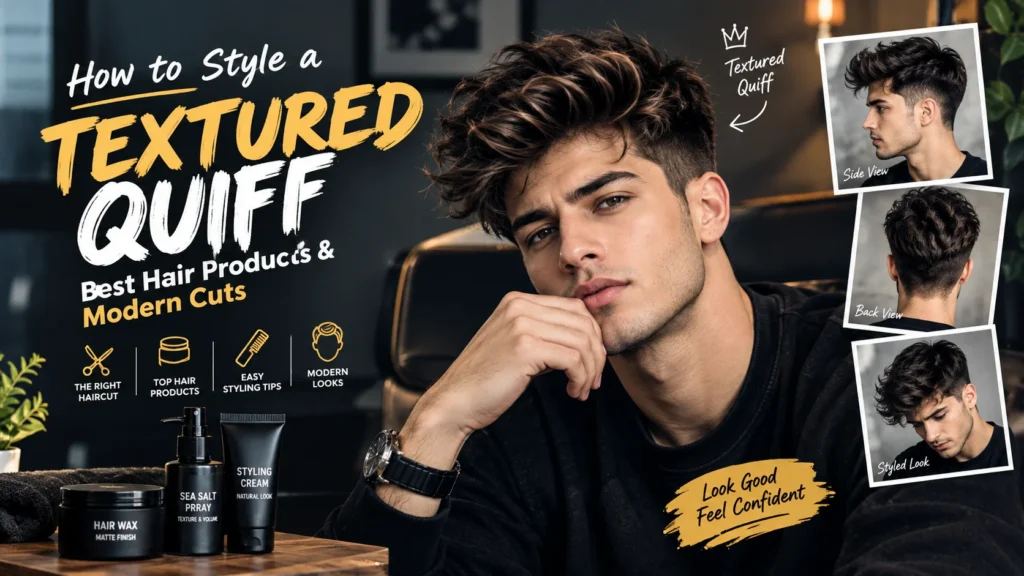
A classic quiff haircut is swept up and back off the forehead, usually with a fairly smooth, polished finish- think a slicked, combed look. A textured quiff takes that same basic shape, height at the front, length tapering back, but the top is cut with heavier layering or point-cutting so it separates into distinct pieces instead of lying in one smooth mass.
The difference matters more than it sounds. A quiff hairstyle men wear smooth and polished reads as more formal, more old-school rockabilly. The textured version reads as current and a bit more relaxed, even though it’s arguably harder to get right, since texture depends on both the right haircut underneath and the right styling on top.
7 Textured Quiff Variations to Know
1. Classic Textured Quiff
The baseline, height, and volume at the front, textured through the crown, tapered or faded sides. This is probably the most requested modern quiff in my chair right now, mostly because it works with almost any face shape and most hair types.
2. Textured Quiff Low Fade
Pairing the quiff with a low fade keeps the blend subtle, starting just above the ears, so the eye goes straight to the texture on top rather than the sides. It’s the version I usually suggest to guys who want something sharp but not too loud.
3. Textured Quiff Mid Fade
A mid fade starts around temple height, giving noticeably more contrast between the short sides and the textured top. It reads as a little more deliberate and polished than the low fade version without going all the way to a high-contrast look.
4. Textured Quiff Taper Fade
Instead of a hard fade line, a taper fade blends more gradually down the sides, which tends to look slightly softer and ages a little better between barber visits since there’s no sharp line to maintain.
5. Quiff Fade With No Fade at All
Not every quiff needs faded sides. A textured quiff no fade keeps a simple taper or even just scissor-cut sides, putting all the attention on the shape and texture up top rather than any contrast underneath. Works especially well on guys who want to keep their sides a bit longer.
6. Textured Quiff Haircut Men With Short Hair Want
Shorter hair can still carry a quiff; it just needs enough length at the front, usually around 2 to 3 inches, to actually lift and hold shape. A shorter textured quiff haircut men ask for tends to need slightly stronger-hold product since there’s less weight pulling it down, which actually makes it easier to style, not harder.
7. Textured Quiff Haircut Men With Long Hair
More length up front means more dramatic height and sweep, but it also means more weight to fight against. A textured quiff haircut for men with longer hair almost always needs a stronger-hold clay or paste plus a blow-dry to really stand up properly, rather than just air-drying and hoping for the best.
Best Products for a Textured Quiff
Product choice honestly makes or breaks this style more than almost any other cut I work with. Here’s what I actually reach for.
Matte Clay for All-Day Hold
A strong matte clay is my default recommendation for most textured quiff styles. It gives serious hold without shine, and unlike wax, it restyles easily with a bit of water if your quiff falls by afternoon, which, if you’re new to this style, it probably will a few times before you get your product amount dialed in.
Sea Salt Spray for a Messy Quiff
If you’re going for a messy quiff rather than a sharp, defined one, a sea salt spray applied to damp hair before blow-drying roughs up the texture and adds grip without the heavier, more structured hold a clay gives. It’s a looser, more undone finish.
Strong-Hold Paste for Long or Thick Hair
Thicker or longer hair usually needs more than clay alone can offer. A firm styling paste gives the structural hold to keep serious height standing through a full day, especially paired with a round-brush blow-dry.
How to Style a Textured Quiff Step by Step
- Towel-dry hair to about 80%, not soaking wet — product distributes unevenly in dripping hair and the quiff won’t lift properly.
- Apply a dime-sized amount of clay or paste, warmed between your palms first until it turns tacky.
- Work the product through from the back toward the front, lifting at the roots rather than smoothing down.
- Use a round brush and a blow-dryer on medium heat, lifting the front section up and back as you dry for maximum height.
- Once mostly dry, finger-style the top to separate pieces and create the texture; don’t comb it smooth, that defeats the entire point.
- For a modern quiff with extra grip through the day, a light mist of sea salt spray over the finished style adds texture without collapsing the height you just built.
Healthy hair holds texture and shape noticeably better than dry or damaged strands, so it’s worth getting your wash routine right too. Our best shampoo for hair health guide has picks that won’t leave hair too stripped to style.
Common Mistakes That Flatten a Textured Quiff
Using too much product is the single biggest issue I see; a dime-sized amount is almost always enough, and piling on more just weighs the texture down into a greasy mess instead of holding it up. The second mistake is combing instead of finger-styling; a comb smooths everything into one flat section and erases the separation that makes a quiff look textured in the first place.
The third mistake is skipping the blow-dry step entirely. Air-drying can work for a looser, messier quiff hairstyle men want for a casual day, but if you’re after real height and a defined modern quiff, a round brush and some heat genuinely aren’t optional; gravity wins every time without them.
Does a Textured Quiff Suit Everyone?
- Round faces generally benefit most from the added height, since it elongates the face and breaks up width.
- Square and oval faces can wear almost any variation on this list without much adjustment needed.
- Fine or thinning hair does better with a lighter clay and a shorter front section, since heavier product and excess length can both look thin and flat rather than full.
- Thick or coarse hair holds a textured quiff hairstyle male clients often want especially well, since there’s already natural volume and grip to work with.
Not sure how it’d actually look on your face shape? Our free AI Hairstyle Simulator lets you upload a selfie and preview a textured quiff before you commit to anything at the salon.
Pairing a Textured Quiff With the Right Sides
If you’re not sure which side treatment to ask for, a low taper fade is one of the most forgiving pairings for a textured quiff, since it grows out cleanly and still looks sharp between trims. A crew cut-style side is another solid option if you want something lower-maintenance underneath all that height on top.
For more reference photos to bring to your next appointment, our celebrity hair inspiration roundup has plenty of quiff variations worth browsing.
How Often to Get a Textured Quiff Trimmed
Book a trim every three to four weeks. The sides grow out fastest and start softening the contrast that makes the style pop, and the front needs occasional thinning to keep the texture from getting too heavy and collapsing under its own weight.
Ready to Get the Cut?
Bring this guide to your next appointment and be specific about front length, fade height, and whether you want a defined or messy finish; that’s the difference between a quiff that photographs well and one that actually holds up at 6 pm.
For more cuts, product guides, and styling breakdowns like this one, head over to CuteHairstyles.org; we’re always testing what’s actually worth your money and your morning routine.
Frequently Asked Questions
What’s the difference between a textured quiff and a textured quiff low fade?
A textured quiff on its own just describes the shape on top. Adding “low fade” specifies the sides too, a subtle blend starting just above the ears, which keeps most of the visual attention on the texture up top rather than the sides.
Can you get a textured quiff haircut men with short hair ask for?
Yes, you just need roughly 2 to 3 inches at the front to create enough height and lift. A shorter textured quiff often holds its shape more easily since there’s less weight working against the product.
Does a textured quiff taper fade look different from a textured quiff with a hard fade?
A taper fade blends more gradually down the sides with no sharp line, giving a softer overall look, while a hard fade creates crisp contrast between the short sides and the textured top. Both pair well with the style; it’s really a matter of preference.
Can you do a textured quiff haircut men with long hair want, or does it need to be short?
Longer hair works fine for a textured quiff, though it needs a stronger-hold product and usually a blow-dry with a round brush to stand up properly, since more length means more weight pulling the shape down.
What does a textured quiff with no fade look like?
A textured quiff no fade keeps the sides simply tapered or scissor-cut rather than faded, putting all the focus on the shape and texture on top. It suits guys who prefer to keep more length on the sides.
How is a textured quiff mid fade different from the other fade heights?
A mid fade starts around temple height, sitting between the subtlety of a low fade and the sharper contrast of a high fade. It’s a solid middle-ground choice if you want visible contrast without it being the first thing people notice.
Final Thoughts
A textured quiff rewards a bit of patience more than most cuts: the right haircut underneath, the right product, and a technique that actually builds height instead of fighting gravity. Once you’ve got those three things dialed in, it becomes one of the lower-effort styles on a day-to-day basis, not a higher one, since a few minutes with clay and a blow-dryer get you there every morning.
Start with a classic textured quiff haircut men request most if you’re new to the style, get comfortable with the product and technique, then branch into a fade, a messy quiff, or a longer version once you know what your hair actually wants to do.