
Table of Contents
My cousin used to set an alarm for six thirty just to do her daughter’s hair before school, and even then they were sometimes late. Not because she didn’t know what she was doing; she genuinely did, but because most of the tutorials she found online assumed a kid who’d sit perfectly still for forty-five minutes. Anyone who’s actually raised a seven-year-old knows that’s fiction.
So this is a more honest list. Real Black kids’ hairstyles sorted by what you’re actually working with that morning: a squirmy toddler, a school day, a special occasion, or just a kid who wants beads because her friend has them. Nothing here needs a salon appointment or a degree in braiding, though a couple of these are worth a proper stylist visit if you can swing it. And a few notes throughout on what actually keeps hair healthy underneath whatever style you land on, because the style is only half of it.
Why Protective Styles Matter More Than People Realize
A lot of guides jump straight into pretty pictures without explaining why certain styles are recommended over and over for Black children’s hair. It comes down to this: textured hair is naturally drier than straighter hair types, since scalp oils have a harder time traveling down a curved strand. Protective styles, braids, twists, puffs, anything that tucks the ends away, cut down on daily manipulation and breakage, which matters a lot more for a kid’s still-developing hair than it does for an adult’s.
The other piece nobody mentions enough is comfort. A style that looks amazing in a photo but leaves a child wincing every time you touch her hairline isn’t actually good. Gentle tension should always win over a flawless part, and honestly, kids remember how getting their hair done felt a lot longer than they remember how it looked in any single photo.
Easy Styles For Little Girls
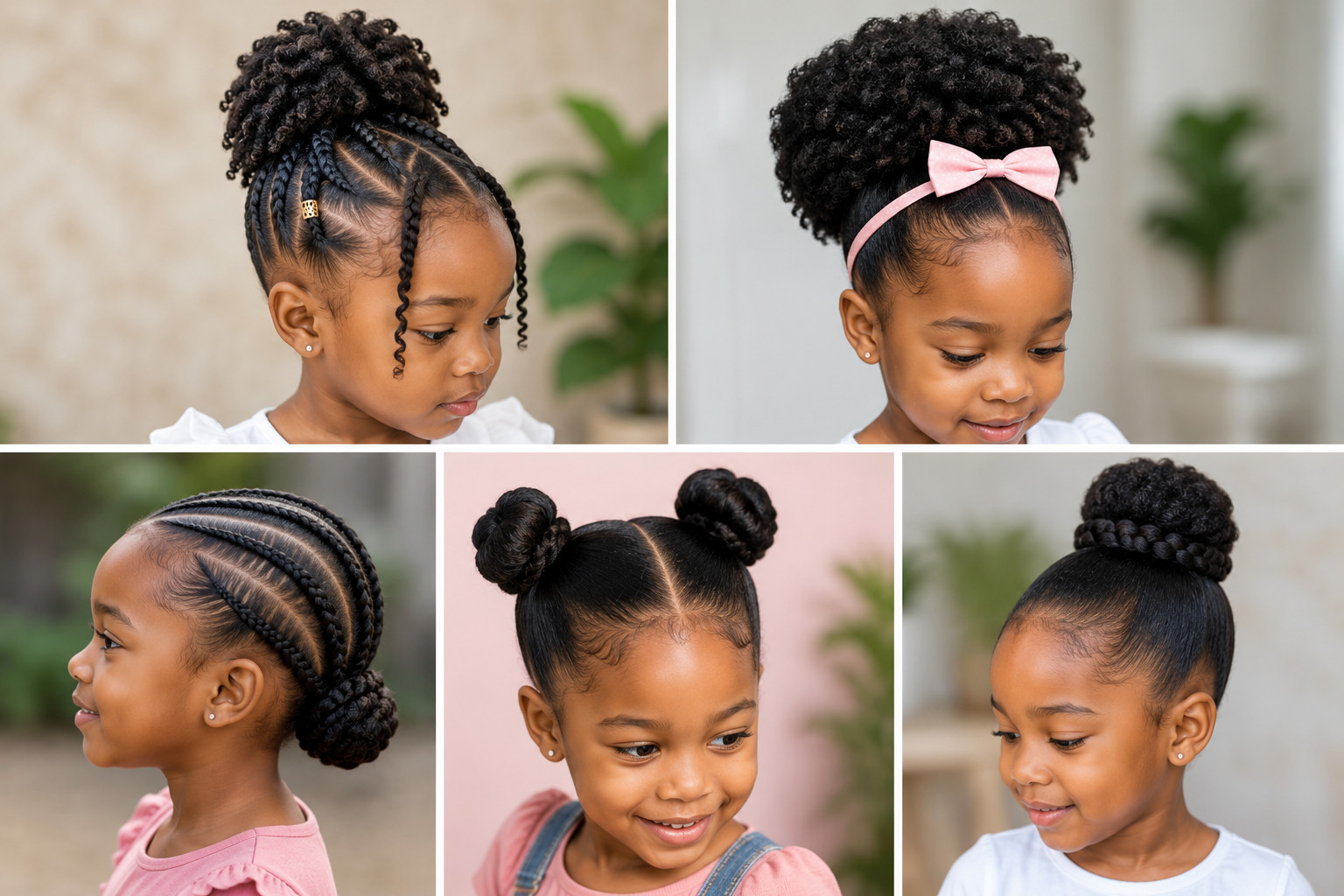
These are the ones that come up again and again in searches for quick, easy kids’ styles, and for good reason; they work.
- Two-strand twists gathered into a puff, twist small sections, then loosely bundle them at the crown. Ten minutes, gentle on a young scalp, holds for days.
- The afro puff, no braiding at all, just gather natural hair up into a puff and let the curls do the talking. Add a headband or a couple of barrettes for extra flair.
- Simple cornrows into a low bun, protective and neat, and it keeps hair off the neck for kids who are constantly moving.
- Space buns, part down the middle, two buns on top, playful and genuinely trendy right now; kids love how bouncy they look.
- A high bun with a braided crown, elegant enough for a photo day but simple enough for a Tuesday, a braid wrapped around the base of a high bun.
For Toddlers, Where Patience Runs Out Fastest
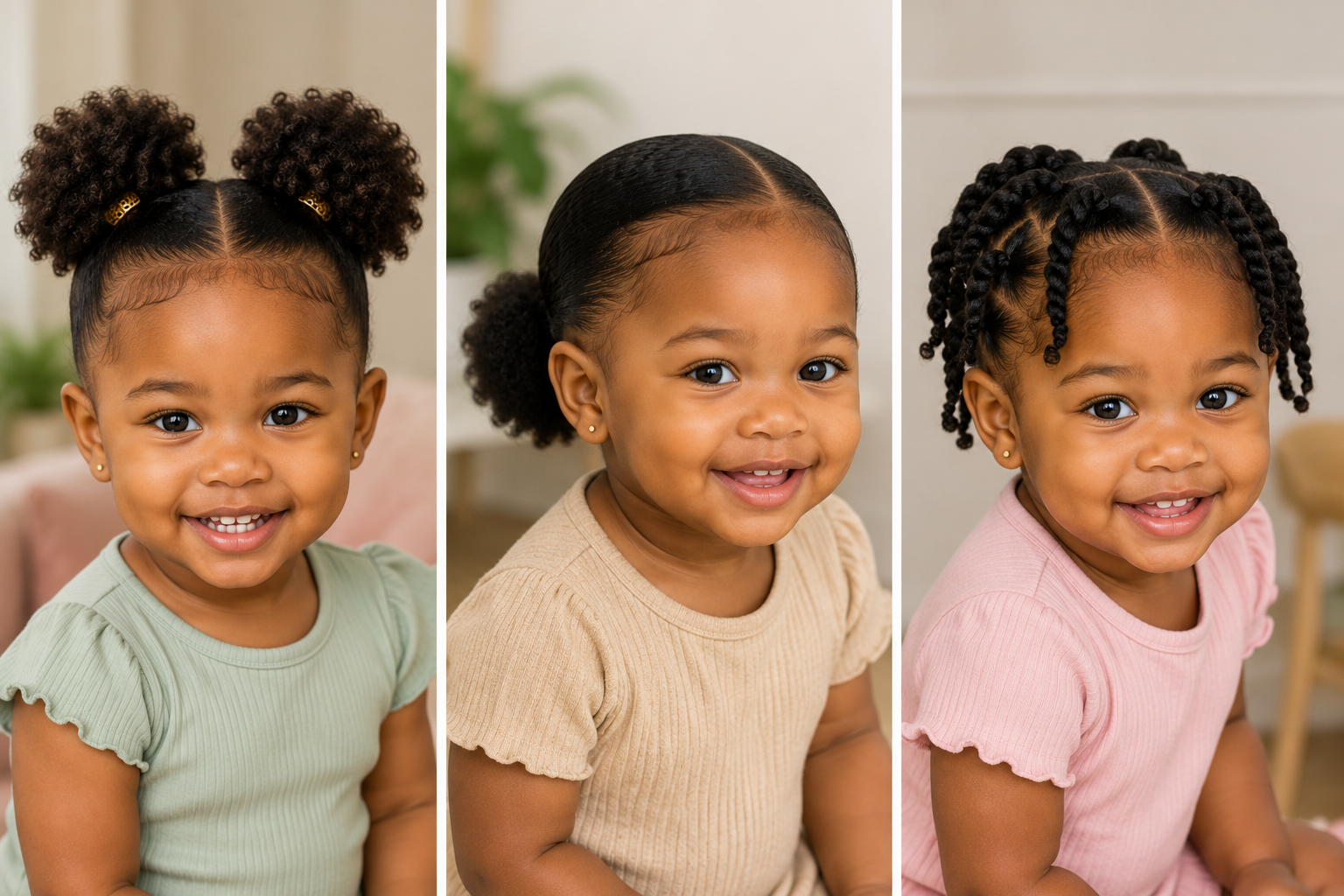
Toddlers are their own category entirely; most of them will tolerate about five minutes of sitting still before they’re done, no matter how good the show playing in front of them is. A few things that genuinely help at this age. Break the style into sessions if you have to, half the head today, the rest tomorrow; nobody’s judging a two-day braid job. Keep sections big and simple; tiny detailed cornrows just aren’t realistic yet. And skip anything requiring them to lie still; do it while they’re sitting up watching something, not lying back over a sink.
- Simple twin puffs, two puffs at the crown, no braiding at all, done in under three minutes.
- A single low puff at the nape, easiest possible option for a toddler who genuinely will not cooperate that day.
- Loose two-strand twists, bigger sections than you’d use on an older kid, quick and gentle.
Tools Worth Actually Having
- A rat-tail comb for clean, straight parts, or a wide-tooth comb for detangling without pulling.
- Small, soft elastics or hair ties made specifically for kids; the snag-free kind saves a lot of tears.
- A spray bottle with water and a little leave-in mixed in; damp hair braids so much easier than dry hair.
- Edge control or a light gel for laying baby hairs; a tiny amount goes a long way on a child’s finer edges.
- A silk scarf or bonnet sized for a kid’s head; adult ones tend to slip off during sleep.
For Ages Around Five To Eight
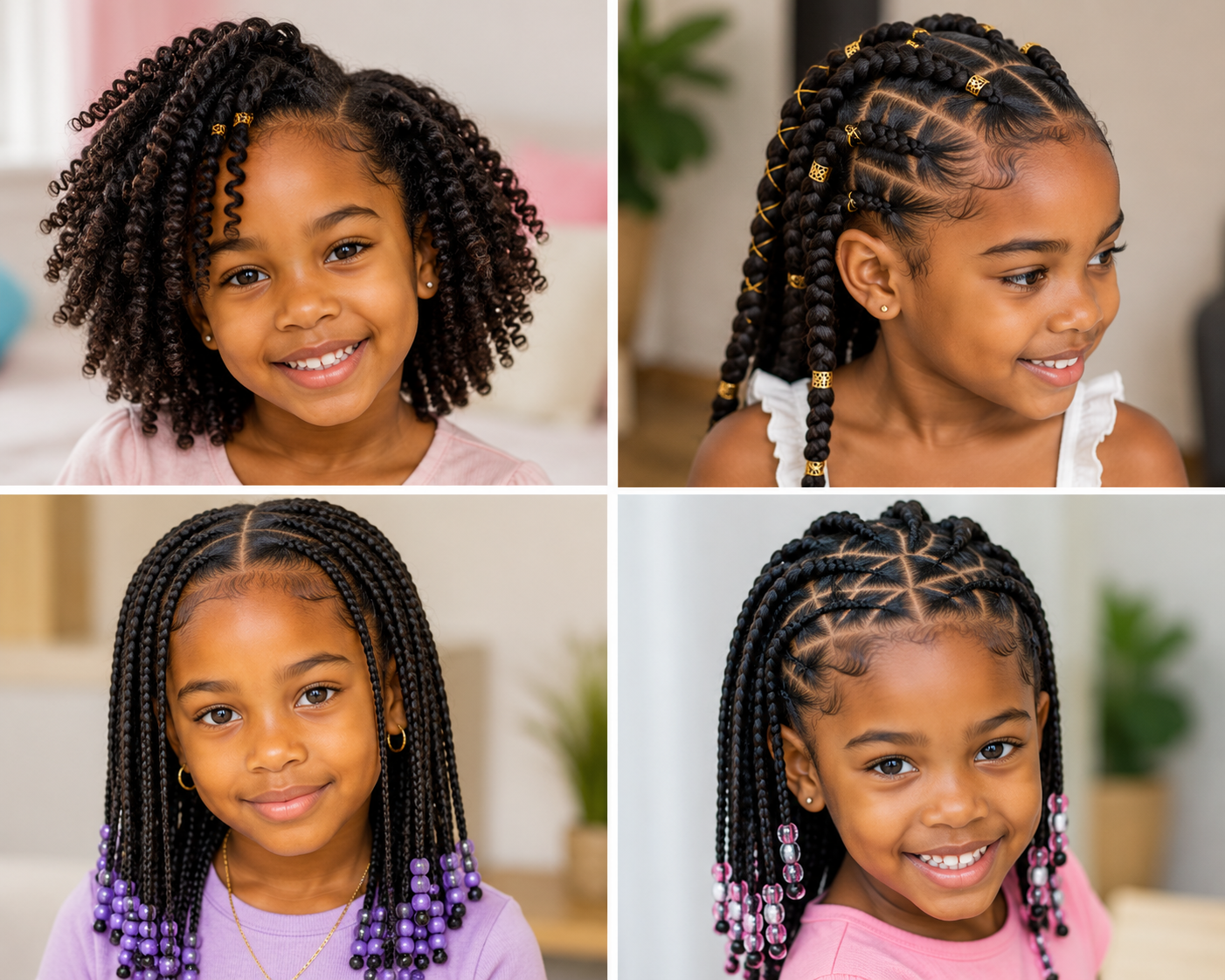
Younger kids in this range usually have a bit more patience than toddlers but still can’t sit for an hour, and their hair is often finer and more delicate than it will be later. A few styles that fit that stage specifically.
- Twist-outs, twist damp, product-loaded hair overnight and unravel in the morning for defined curls with zero heat involved.
- Goddess braids, larger, chunkier braids close to the scalp, genuinely striking for a special occasion and easy to dress up with beads or gold cuffs.
- Small box braids or knotless braids, longer-lasting for this age group since their hair grows fast and needs a style that keeps up, knotless especially since it’s gentler at the root.
- A playful geometric part, zigzags or triangle sections instead of straight lines, it makes an ordinary braid pattern feel a little more fun without adding real extra time.
Boys’ Styles Worth Knowing Too
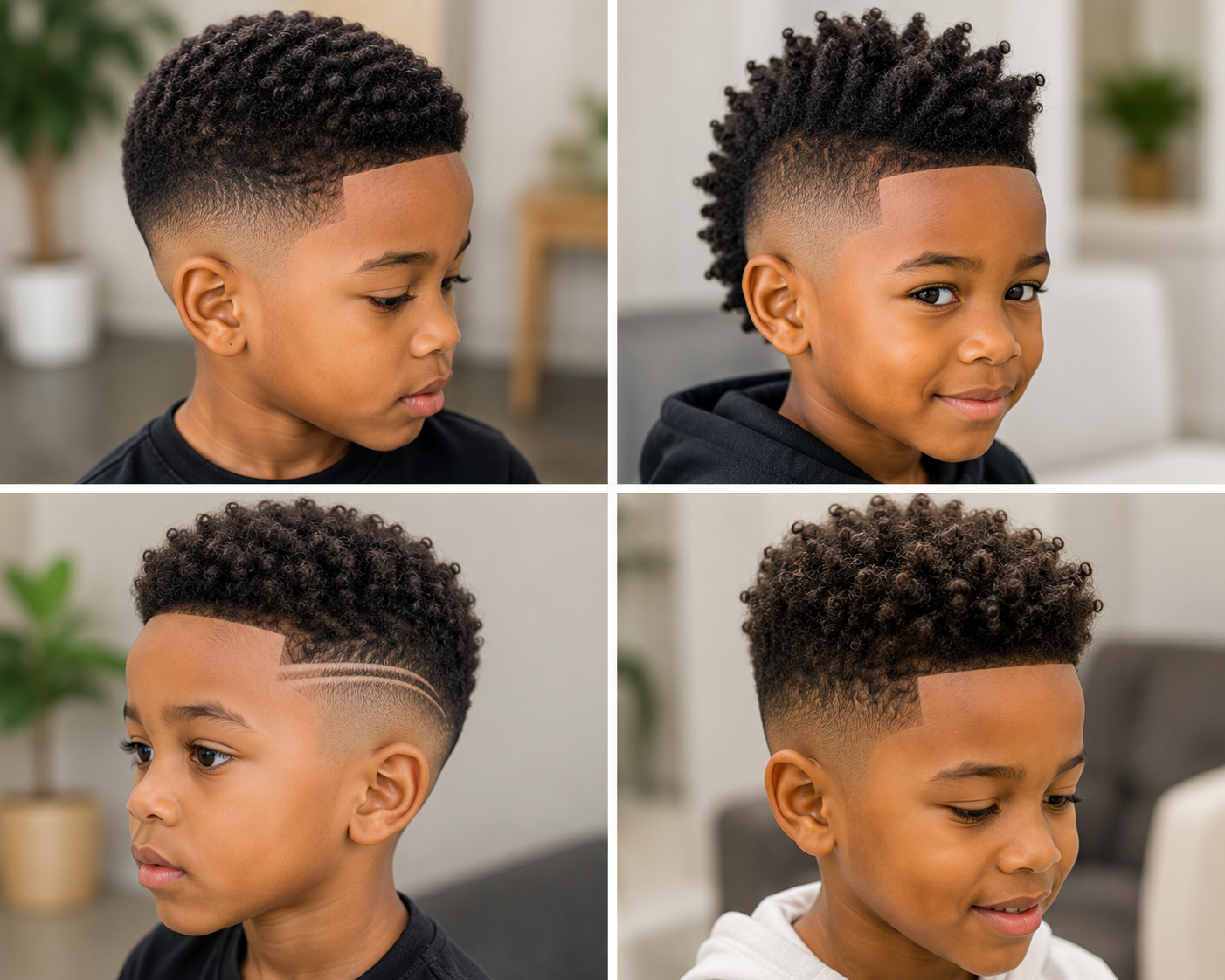
Most guides for Black kids’ hairstyles focus almost entirely on girls, which leaves out a whole side of this. Boys have real options too.
- A taper or low fade, clean, low-maintenance, and works with any curl pattern underneath.
- A frohawk, twists or coils gathered upward through the center for a bold, playful silhouette that still keeps the sides neat.
- A design part, a shaved line or two through a fade adds a little personal flair without changing the actual cut.
- A curly top fade, longer curls left on top with a faded side, low-maintenance and genuinely versatile as the hair grows.
Beads, Accessories, And Keeping It Fun
Beads and barrettes turn a plain style into something a kid actually gets excited about, and that excitement is worth something on a rushed morning. A few practical notes though: lightweight beads sit more comfortably than heavy ones, and always double-check that anything small is secured well; loose beads are a real choking hazard around younger siblings. For a bit of fun, some parents shape sections into playful silhouettes; Mickey Mouse ears made from two buns is a genuine favorite for younger kids and takes under five minutes.
Special Occasion Styles
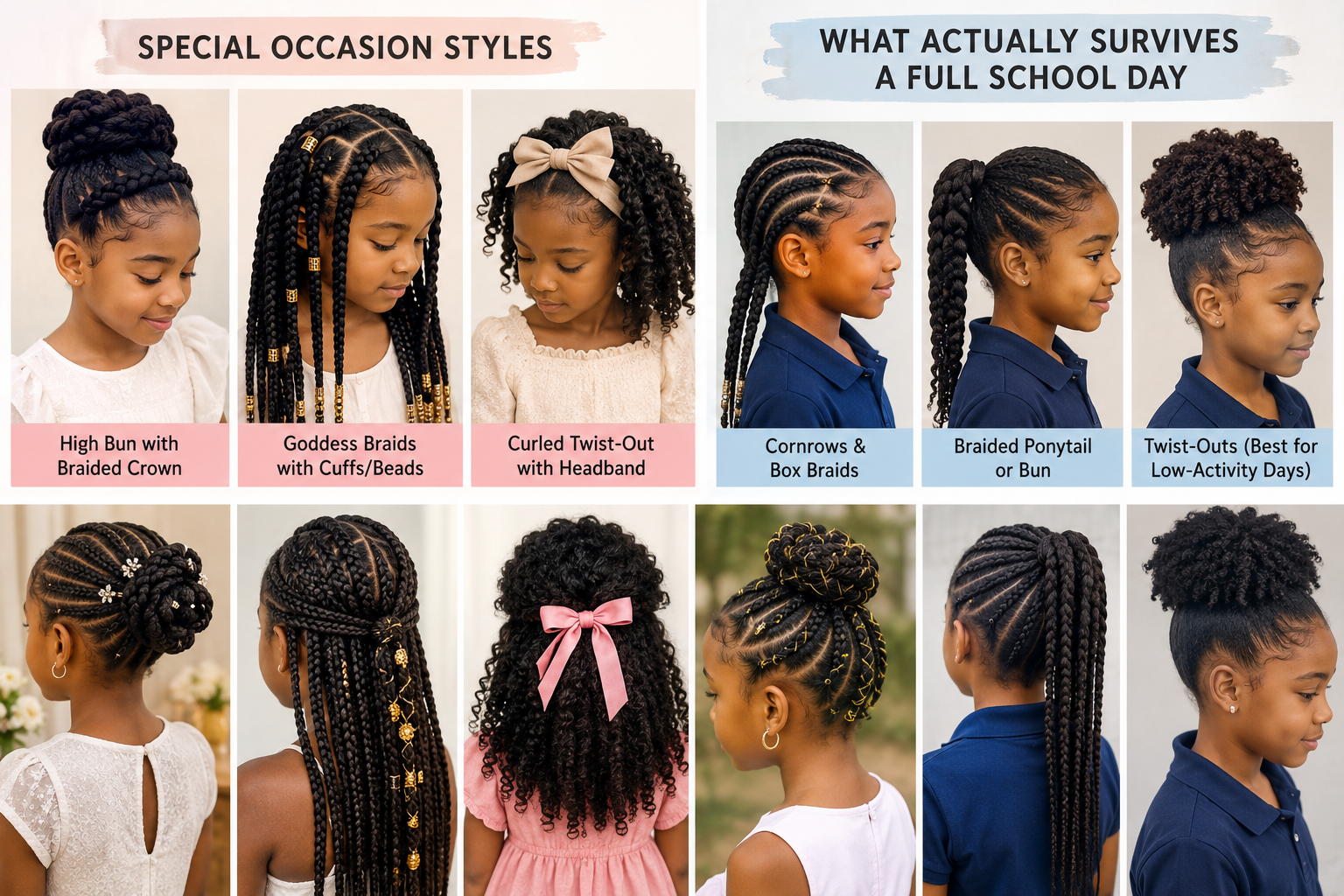
For picture day, a recital, or a family event, it’s worth spending a bit more time than a regular school morning allows. A high bun with a braided crown reads elegant without needing much beyond what you already know how to do. Goddess braids dressed up with gold cuffs or a few beads feel intentional and celebratory. And for a really special moment, a curled twist-out with a headband or bow pulls together in a way that photographs beautifully without a single heat tool involved.
What Actually Survives A Full School Day
Cornrows and box braids hold up best through gym class and recess since there’s minimal loose hair to get tangled or tugged by classmates. A simple braided ponytail or bun is the safest bet for picture day; it holds a clean shape for hours without needing a touch-up. And twist-outs, while gorgeous, are better saved for days without heavy physical activity since the definition can loosen with a lot of running around.
Mistakes Worth Avoiding
Braiding too tight is the big one. If a child is wincing or pulling away while you work, that’s not a tolerance issue; that’s the braid being too tight, and repeated tension in the same spots can genuinely thin the hairline over time. Leaving a protective style in too long is another; most kids’ braids or twists start looking rough and matting near the root after about two to three weeks. Past that point, removal gets a lot harder and riskier for breakage. And skipping moisture between styles is a quiet one; a protective style still needs the scalp underneath cared for, not just left alone until removal day. It’s easy to treat a protective style as a break from hair care entirely, but it’s really just a different kind of care, not an absence of it.
Keeping Hair Actually Healthy Between Styles
- Moisturize regularly with a leave-in conditioner and a light oil like coconut or jojoba to lock it in.
- Don’t overwash; once a week or every couple of weeks is usually plenty; more than that strips natural oils a kid’s hair needs.
- Deep condition on wash day; it makes the biggest visible difference in how manageable the hair is during styling.
- Use a silk or satin bonnet or pillowcase at night; it protects whatever style is currently in and cuts down on breakage from cotton friction.
- Keep tension gentle always; no style is worth a child’s discomfort, and repeated tight styling can cause real damage at the hairline over time.
Frequently Asked Questions
What are easy hairstyles for a Black girl?
Two-strand twists into a puff, an afro puff, or simple cornrows into a low bun are the quickest, all doable in under fifteen minutes without any advanced braiding skill.
What are easy hairstyles for girls in general with textured hair?
Space buns, a high bun with a braided crown, and twist-outs cover most requests; they’re quick, protective, and genuinely flattering on most face shapes.
What holds up best for school?
Cornrows, a braided low bun, or simple box braids hold up best through a full school day, gym class and recess included, without needing a midday fix.
What are good hairstyles for a 7-year-old?
Twist-outs, small knotless braids, or goddess braids all suit this age well; their hair is often more delicate at this stage, so gentler, lower-tension styles are worth prioritizing over anything elaborate.
What are easy braid options?
Simple cornrows, two-strand twists, or a basic three-strand braid into pigtails are the most beginner-friendly; no special tools needed beyond a rat-tail comb and some elastics.
What are some simple styles for girls overall?
The afro puff and two-strand twists into a puff are probably the two simplest of all; both take minutes, need almost no product, and work well on nearly any length.
When To Bring In A Stylist
Not everything needs to happen at your kitchen table. Small or micro braids, anything involving added hair, or a first-time protective style on very thick or dense hair genuinely goes faster and holds better with a professional, especially one who specifically works with kids. Ask upfront how they handle tension on young scalps; a good kids’ stylist will actually talk you through this without being asked twice, and won’t rush through the front hairline just to save time. It costs more than doing it yourself, but for a special occasion or a longer-lasting style, it’s often worth it, both for the result and for saving your own Saturday morning.
The Honest Takeaway
You don’t need a huge rotation to get through a school year of hairstyles without stress. Two or three reliable go-tos, one for rushed mornings, one protective style that lasts a week or two, and one for special occasions, will genuinely carry you most of the time. Keep tension gentle, let your child pick the beads or accessories when you can, and don’t stress over a slightly uneven part. A quick, comfortable style beats a perfect one that took forty-five minutes and ended in tears, every single time, and that’s worth remembering long after this particular school year wraps up.