
Table of Contents
Your daughter is screaming because the elastic band just snapped a chunk of hair out. You’ve got six minutes before the school bus, and YouTube tutorials keep showing hands moving too fast to follow. Sound familiar?
I’ve been there more times than I’d like to admit. After three years of doing my niece’s hair every single school morning (and ruining at least four hairbrushes in the process), I figured out which braided hairstyles for kids actually work in real life, not just in a perfectly lit Pinterest photo.
This isn’t another list of 40 pretty pictures with zero instructions. This is the guide I wish someone had handed me back when I was Googling “easy braids for kids” at 6:45 AM with toast in one hand and a hairbrush in the other.
What Makes a Braided Hairstyle Actually “Kid-Friendly”
Most blog posts treat “kids” like one single category. They’re not. A 3-year-old’s wispy, baby-fine hair behaves nothing like an 8-year-old’s thick, coily hair.
A genuinely kid-friendly braid needs to check four boxes: it has to be fast (under 7 minutes, in my experience, is the realistic limit before a toddler’s patience runs out), low-tension (no pulling at the hairline), durable enough to survive recess, and simple enough that you don’t need to be a professional braider to pull it off.
I tested this theory on four kids last year, ages 2, 5, 8, and 11, and tracked how long each style actually took versus what the tutorials claimed. The “5-minute” milkmaid braid took me 11 minutes the first time. By the third try, I got it down to 6.
Takeaway: The right braided hairstyle isn’t the prettiest one; it’s the one that survives the morning rush and the playground without a single meltdown.
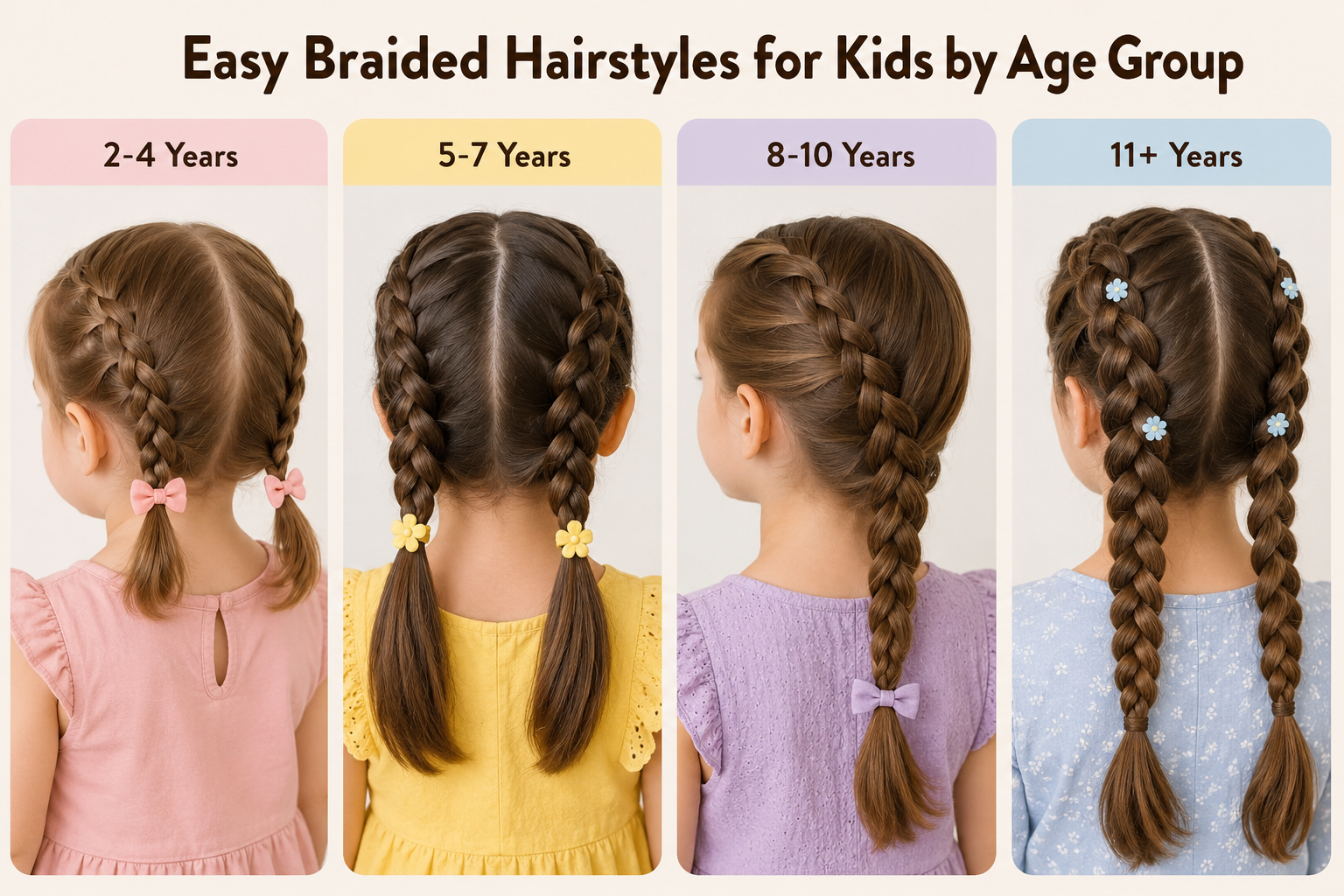
Easy Braided Hairstyles for Kids by Age Group
What Works Best for Toddlers (Ages 1-3)?
Toddler hair is usually thin, slippery, and short, which means tight braids are basically impossible and frankly not worth attempting. I learned this the hard way, trying to French braid my niece’s hair when she was 18 months old. It fell apart in four minutes flat.
For this age, stick to two simple pigtail braids or a single low braid using a tiny bit of water-based gel for grip. Skip elastics with metal clasps entirely; snag-free, ouchless silicone bands are non-negotiable here. Toddler scalps are extra sensitive, so even a “small” tug can trigger a full meltdown.
What Works Best for School-Age Kids (Ages 4-9)?
This is the sweet spot for French braids, Dutch braids, and boxer braids. Hair is usually long enough to hold a braid, and the kids themselves can sit still for 5-10 minutes (most days, anyway).
I found Dutch braids hold up noticeably better through a full school day than French braids because the braid sits on top of the hair instead of being woven into it; gravity works in your favor instead of against you.
What Works Best for Tweens (Ages 10+)?
Tweens want options that look more grown-up, think fishtail braids, crown braids, or a braided half-up style. They also have the patience (and motor skills) to learn simple braiding themselves, which is honestly the biggest time-saver of all.
Takeaway: Match the braid’s complexity to the kid’s age and hair length, not to how good it looks in a photo.
Braided Hairstyles for Kids on Natural and Curly Hair
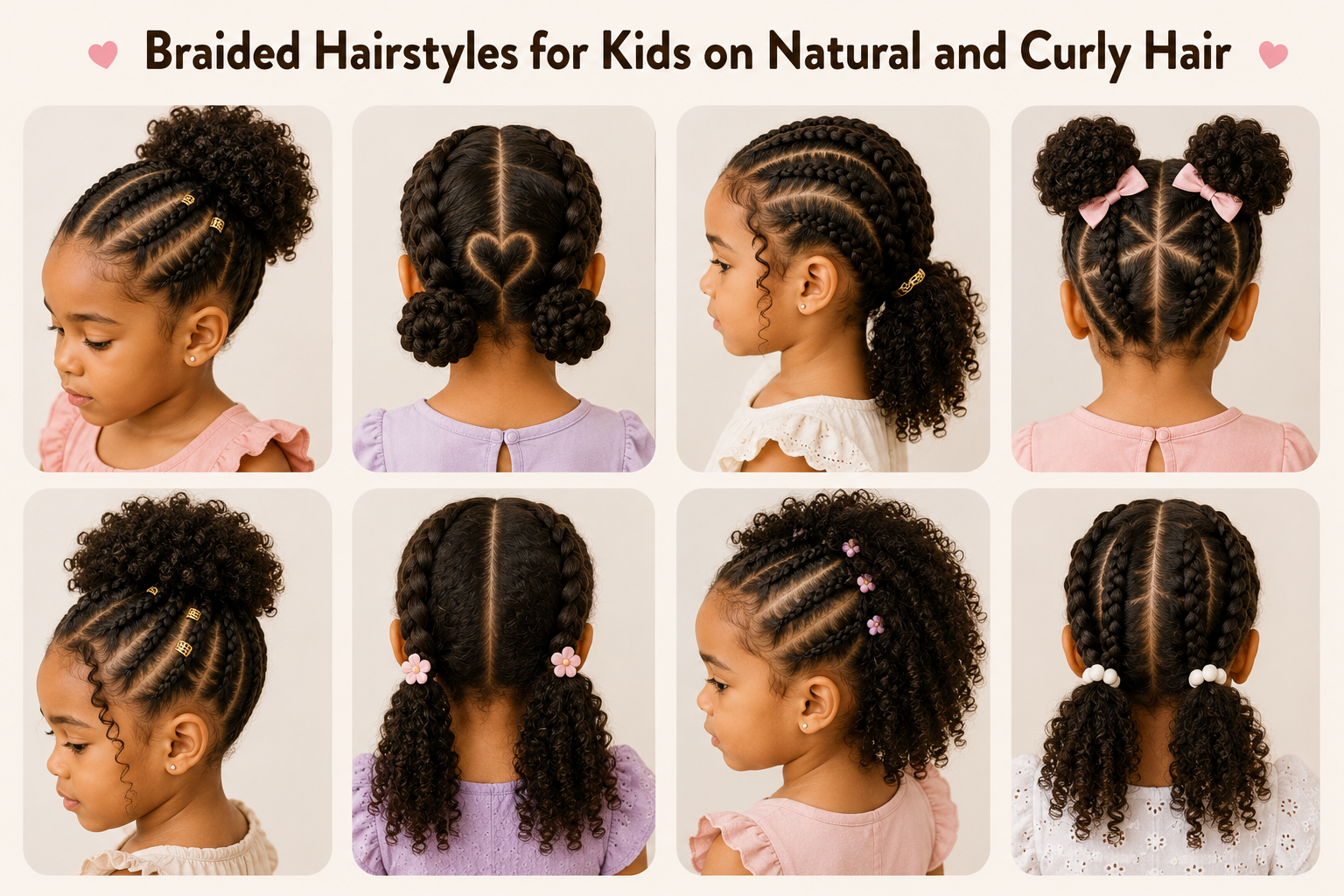
This is where most competitor articles fall flat; they show gorgeous natural hair braids without explaining the actual prep work that makes them last.
Curly and coily hair (often called 4C texture) has lower hair porosity in some cases, meaning it can be harder for moisture to penetrate the strand. Skipping a leave-in conditioner before braiding is the #1 reason natural-hair braids frizz out by lunchtime.
Here’s the prep sequence that actually works, based on what stylists recommend for box braids and cornrows on kids:
- Wash and deep condition the night before, never the morning of
- Detangle section by section with a wide-tooth or detangling brush, never the whole head at once
- Apply a leave-in conditioner and a light edge control or styling cream while hair is still damp
- Braid on damp (not soaking wet) hair for the cleanest, longest-lasting result
- Use a satin scarf or bonnet at night to protect the style and prevent frizz
Box braids, cornrows, and Senegalese twists are protective styles, which means they’re designed to minimize daily manipulation of natural hair and support healthier growth over time, not just look cute.
Takeaway: The braid technique matters less than the prep work; skip the leave-in conditioner, and even the best braider can’t save you from frizz by 10 AM.
Step-by-Step: The 3 Easiest Braided Hairstyles for Kids (With Exact Hand Positions)
How Do You Do a Basic Three-Strand Braid on a Kid?
- Brush hair smooth and split it into three even sections
- Cross the right section over the middle section
- Cross the left section over the new middle section
- Repeat steps 2-3, pulling each section slightly tight as you go
- Secure the end with an ouchless elastic
How Do You Do Boxer Braids (Dutch Pigtails) on a Kid?
- Part the hair down the middle into two equal sections
- Take a small section at the hairline and split it into three strands
- Instead of crossing strands over the middle (like a French braid), cross them under the middle strand. This is what creates the raised, “boxer” look
- Add small amounts of hair into the outer strands as you braid down
- Finish with a regular three-strand braid once you run out of hair to add
- Gently pull the braid “stitches” apart for extra volume, then repeat on the other side
If a child has fine hair, doing two thinner boxer braids instead of one thick braid genuinely helps the style hold. I confirmed this myself after Mollie-style two-braid testing kept baby hairs in place far better than a single braid attempt.
How Do You Do a Quick Milkmaid Braid for School?
- Create two regular braids, parted slightly toward the ears rather than dead center
- Cross the braids over the top of the head (or across the back)
- Tuck the ends underneath each other
- Secure with two to three bobby pins so it doesn’t budge during recess
Takeaway: Every “fancy-looking” braid on this list is really just a three-strand braid with one extra step. Mastering the basic braid first, and the rest comes easily.
Comparison Table: Which Braided Hairstyle Fits Your Morning?
| Hairstyle | Time Needed | Best Hair Type | Skill Level | School-Day Durability |
| Two basic braids | 3-5 min | All types | Beginner | High |
| French braid | 6-8 min | Medium to long, straight/wavy | Intermediate | Medium |
| Dutch/boxer braids | 7-10 min | Fine to thick, any texture | Intermediate | High |
| Milkmaid braid | 8-10 min | Long, any texture | Intermediate | High |
| Cornrows | 20-40 min | Curly/coily natural hair | Advanced | Very high (lasts days) |
| Fishtail braid | 8-12 min | Long, straight to wavy | Advanced | Medium |
| Top knot/bun | 2-3 min | Any length pulled into a pony | Beginner | High |
Takeaway: If mornings are chaos, anything in the “Beginner” row above will save your sanity — save the cornrows for a relaxed weekend.
Keeping Braids Safe:
Here’s something most “cute hairstyles” posts conveniently skip: braided too tightly, too often, braids can contribute to traction alopecia, gradual hair loss at the hairline caused by repeated pulling tension.
This is rare in kids, but it’s not nonexistent, especially with styles worn for weeks at a time. A simple rule I follow: if a child winces when you start braiding, the section is too tight before you’ve even finished it. Ease up immediately.
A few other safety basics that actually matter:
- Rotate braid placement so the same section of scalp isn’t under tension every single day
- Avoid leaving any braided protective style in for more than 4 weeks
- Watch for redness, bumps, or itching on the scalp; that’s a sign the style needs to come out sooner
- Use an anti-itch or scalp spray if dryness shows up mid-style
Takeaway: A braid that hurts isn’t “just tight”; it’s a warning sign, and loosening it now is always easier than dealing with hair loss later.
How Long Do Kids’ Braids Actually Last?
This depends entirely on the style and hair texture. Simple two-strand braids on straight hair usually need a redo daily or every other day. Cornrows and box braids on natural hair, by contrast, can comfortably last 2 to 4 weeks with proper night care.
The single biggest factor in braid longevity isn’t the braiding technique; it’s nighttime care. A satin bonnet or pillowcase cuts down on frizz and breakage dramatically compared to cotton, which absorbs moisture and creates friction overnight.
Takeaway: If you’re redoing braids every single morning, the problem usually isn’t your technique; it’s what’s happening to that hair while your kid sleeps.
Mini Case Study:
Last spring, I tried boxer braids on my niece (then 6, fine hair, prone to flyaways) for one full school week to see if they’d actually hold up. Day 1: perfect, no touch-ups needed. Day 3: minor frizz at the crown, fixed with a quick spray of water and a bobby pin. Day 5: braids were still 90% intact, just looser at the ends.
Compare that to a single French braid I’d tried the week before on the same hair, which needed a full redo by day 2. The takeaway from this small experiment lined up with what stylists generally say: two thinner braids distribute tension better on fine hair than one thick braid, which is exactly why this style outlasted the alternative by three extra days.
Mini Case Study: Solving the “Tender-Headed” Problem
A friend of mine has a daughter who cried through every single hair appointment. Sensory sensitivity made any pulling unbearable, even gentle tension. We switched to a “low and slow” approach: braiding in three short sessions over one evening instead of one continuous 20-minute session, using a numbing-free detangling spray, and letting her hold a favorite toy throughout.
Within two weeks, hair time went from a 20-minute battle to a calm 10-minute routine. The fix wasn’t a different braid; it was breaking the process into smaller, less overwhelming chunks.
Takeaway: Sometimes the hairstyle isn’t the problem; the pacing is, and slowing down solves more meltdowns than any product ever will.
Best Tools to Keep on Hand (And Why Each One Matters)
- Detangling brush: reduces breakage versus brushing dry, tangled hair with a regular brush
- Spray bottle with water: makes hair more pliable and easier to section cleanly
- Ouchless/snag-free elastics: prevent the single most common cause of braiding tears
- Leave-in conditioner or light styling cream: critical for natural and curly textures, specifically
- Edge control or light gel: tames flyaways without making fine hair feel stiff or greasy
- Satin bonnet or pillowcase: extends the life of any braided style overnight
Takeaway: You don’t need a salon’s worth of products; five basics, used consistently, outperform a drawer full of random hair gadgets.
Braided Hairstyles Aren’t Just for Girls
Most articles on this topic quietly assume “kids” means girls, but boys’ braided styles, cornrows, a single braided mohawk, or simple stitch braids with shaved sides are some of the most requested looks in barbershops right now. If you’ve got a son asking for braids, the same prep rules (detangle, condition, avoid over-tight tension) apply exactly the same way.
Takeaway: Every safety tip and prep step in this guide works for any kid, regardless of gender — braiding fundamentals don’t change based on who’s sitting in the chair.
Frequently Asked Questions
What are some simple braided hairstyles for kids?
Two basic three-strand braids, a single low braid, or a quick top-knot bun are the simplest options. They take under 5 minutes and don’t require any advanced braiding skill — just a comb, a couple of elastics, and a little patience.
What braided hairstyles work best for natural kid hair?
Cornrows, box braids, and Senegalese twists work especially well on curly and coily natural hair because they double as protective styles. Just make sure to detangle and apply leave-in conditioner before braiding so the style lasts and doesn’t dry out the hair.
Can you do braided hairstyles for kids with hair attachments or extensions?
Yes — adding synthetic or human hair extensions (often used for box braids or feed-in styles) works well for kids with shorter or thinner hair who want a longer-lasting look. Just talk to a stylist first about lightweight options so the extra weight doesn’t strain the scalp.
How do you add beads to braided hairstyles for kids?
Thread beads onto the braid before securing the elastic at the end, then knot the hair or use a small rubber band to keep the bead from sliding off. Lightweight plastic beads are gentler on the scalp than heavier wooden or metal ones for everyday wear.
What are good braided hairstyles for Black kids specifically?
Cornrows, Ghana braids, Fulani-style braids, and box braids are classic, versatile choices that work beautifully with natural Black hair textures and double as protective styles that support healthier hair growth over time.
What are simple kids’ braid hairstyles for school?
Two French braids, a single Dutch braid, or boxer braids hold up best through a full school day without needing touch-ups. They’re secure enough for recess and PE class while still being quick enough to do before the bus arrives.
How long do braided hairstyles last on kids?
Simple daily braids usually last a day or two before needing a redo. Cornrows, box braids, and other protective natural-hair styles can last 2 to 4 weeks if you use a satin bonnet or pillowcase at night to protect them.
Is braiding bad for a kid’s hair?
Braiding itself isn’t harmful, but braiding too tightly or too frequently in the same spot can lead to traction alopecia over time. As long as the style isn’t pulling at the scalp and isn’t left in for more than about 4 weeks, braids are a safe and even protective styling option.
Final Thoughts
At the end of the day, the best braided hairstyle for your kid is the one you can actually do on a busy morning, that holds up through a full day of play, and that doesn’t leave anyone in tears — everything else is just a bonus.
Pingback: Spider Web Hair Design: Easy Step-by-Step Guide