
Table of Contents
You’ve got exactly four minutes before the school bus arrives and your daughter is standing there, hair going in seven different directions, refusing to sit still.
Sound familiar? You’re not alone and you’re definitely not doing it wrong. You just need the right style for her specific hair type, matched to the time you actually have.
Most hairstyle roundups show you 40 pretty pictures and leave you figuring out the rest. This guide is different. Every style here comes with hair type guidance, a realistic time estimate, a difficulty rating, and tips for when your little one won’t stop wiggling. We’ve also covered ground that no other guide touches from 4C natural hair to sensory-friendly styling for kids who find hair brushing genuinely distressing.
Whether she’s two years old with baby fine hair or a tween with thick coils, you’ll leave this page knowing exactly what to do tomorrow morning.
The Master Guide: Best Hairstyles by Hair Type (Quick Reference)
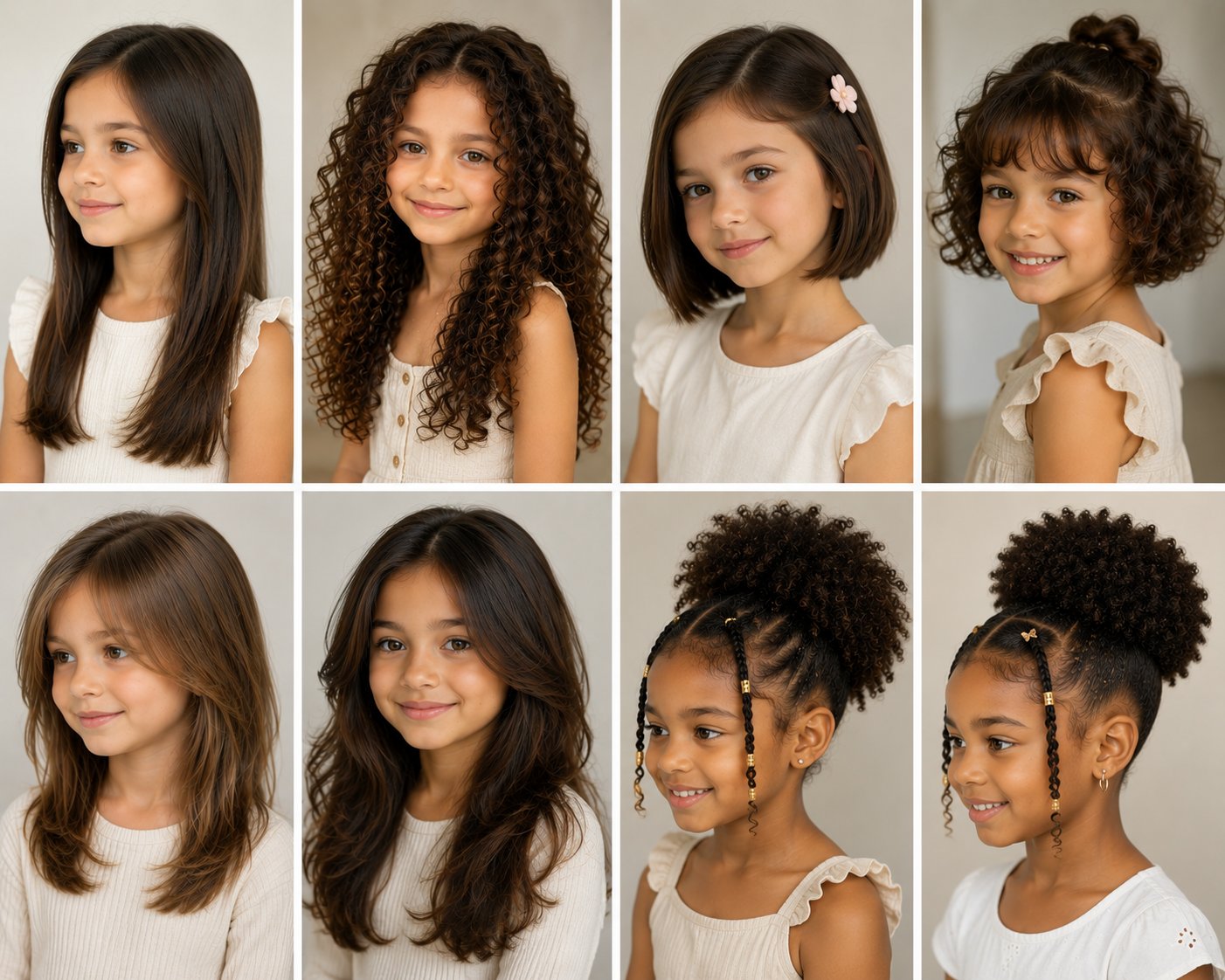
Before we get into individual styles, here’s the truth most guides skip: the same hairstyle looks completely different and behaves completely differently depending on your daughter’s hair texture. A fishtail braid on silky straight hair is a 6-minute job. On thick, coily hair? That’s a whole Saturday afternoon project without the right prep.
Use this table to instantly find your daughter’s hair type and the styles that’ll actually work for her.
| Hair Type | Best Style | Tools Needed | Time | Difficulty |
| Long Straight | Dutch Braid / Fishtail | Comb, elastics, serum | 8–12 min | Beginner |
| Long Curly/Coily | Puff, Box Braids, Braid-out | Wide-tooth comb, leave-in | 10–20 min | Intermediate |
| Short Straight | Half-up bow, Textured cut | Bobby pins, texturizing spray | 3–5 min | Beginner |
| Short Curly | Twist-out, Flat twist, Afro puff | Detangling spray, flexi rods | 5–15 min | Beginner |
| Fine/Thin Hair | Stacked bob, Low ponytail, Baubles | Volumizing mousse, elastics | 5–8 min | Beginner |
| Thick Hair | Space buns, Waterfall braid, Bun | Strong elastics, bobby pins | 10–15 min | Intermediate |
| 4C / Natural Hair | Cornrows, Bantu knots, Flat twist | Edge control, rat-tail comb | 15–30 min | Intermediate |
| Mixed Texture | Twist-out, Half-up braid | Leave-in, Denman brush | 10–20 min | Intermediate |
Hairstyles by Age Group:
Here’s something nobody tells you: a hairstyle appropriate for a 9-year-old can be a genuine safety hazard for a 2-year-old. Tight elastics on fine baby hair can break it. Heavy styles on toddlers pull on scalps that haven’t fully matured yet.
Let’s break this down by age properly.
Ages 2–3: Keep It Simple, Keep It Loose
Toddlers move constantly. They also have the softest, most delicate hair of their lives right now and it breaks easily if you’re too rough or use the wrong accessories.
Best styles: soft low ponytail, two loose pigtails with gentle baubles, half-up with a fabric scrunchie. That’s genuinely it. Anything more complex is fighting the physics of a toddler.
- Use soft fabric scrunchies never tight rubber bands directly on hair
- Section hair with a wide-tooth comb, not a fine-tooth brush
- Keep styling sessions under 3 minutes distraction with a toy or snack helps
- Detangling spray is your best friend at this age
Ages 4–6: Ready for Real Styles
This is where things get fun. At 4–6, kids can sit still for 5–8 minutes (mostly), they start having opinions about their hair, and their hair is thick enough to actually hold styles.
French braids, Dutch braids, simple fishtail pigtails, the classic half-up with a bow all very doable here. A 5-minute Dutch braid tutorial watched once on YouTube will serve you for the next three years.
- Introduce the concept of ‘hairstyle time’ as a positive routine
- Let her pick the hair tie color buy-in makes the whole thing easier
- Waterfall braids and bubble ponytails are crowd favorites at this age
- School hairstyles that hold: French braid, Dutch braid, braided bun
Ages 7–10: They Want Trendy, You Want Quick
The tween years start earlier than most parents expect. By age 8, many girls are watching hairstyle videos on YouTube themselves and arriving with very specific requests.
Good news: they can also help hold sections, hand you bobby pins, and even start learning to do their own styles. At 9–10, many girls can manage a basic three-strand braid or a claw clip bun independently.
- Heart parting designs and butterfly stitch braids are trending heavily in 2026
- Claw clips are a genuine lifesaver messy bun in under 90 seconds
- Space buns, double buns, half-up twisted styles all work brilliantly here
- Start teaching self-styling it builds confidence and saves you time
Braids for Girls: Dutch, French, Fishtail, Waterfall & Beyond
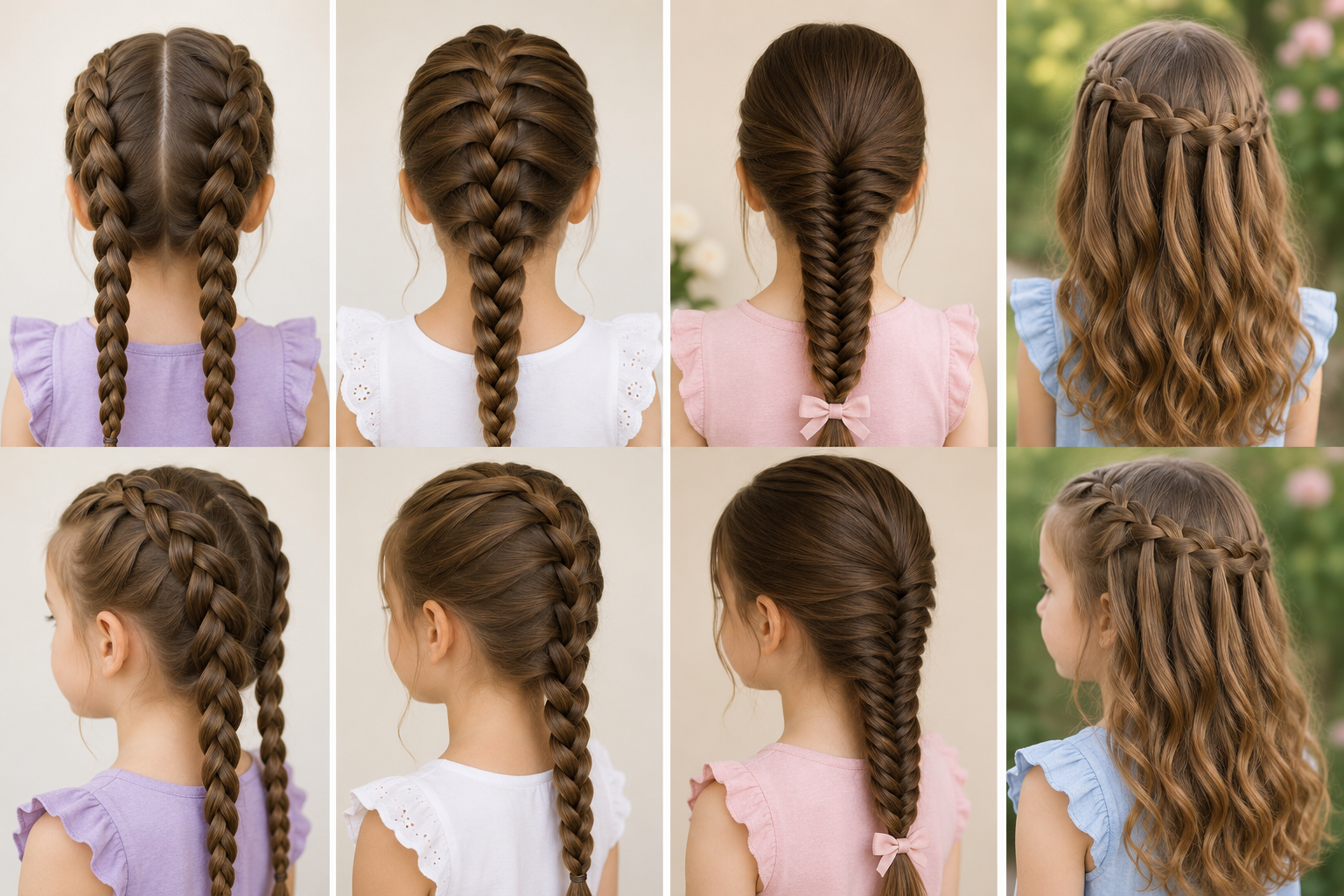
Braids are the workhorse of kids’ hairstyling. They’re versatile, they hold all day, they keep hair out of faces during school and play, and they look intentional even when you do them in 8 minutes half-asleep.
But ‘just braid her hair’ is as helpful as ‘just write the code.’ Let’s get specific.
Dutch Braid vs French Braid:
The Dutch braid (also called an ‘inverted French braid’ or ‘3D braid’) sits on top of the hair and gives that raised, sculpted look. The French braid lies flat against the scalp. Both use the same three-strand technique; the only difference is whether you cross strands over or under.
If you’re learning from scratch, start with the French braid. It’s more forgiving on finer hair. Once you’ve got that, the Dutch braid is just a 5-minute switch of direction.
Fishtail Braid:
The fishtail braid is genuinely one of the most impressive-looking styles relative to how easy it actually is. You only use two sections, not three. You alternate taking small pieces from each side and crossing them over.
It takes slightly longer than a regular braid about 10–12 minutes the first few times but once you’ve done it 5 times, it’s a 6-minute style that makes you look like a professional.
- Works best on medium to long hair
- Secure the end with a small clear elastic
- Pull gently on sections after finishing for a fuller, more voluminous look
- Messy fishtail = trendy, not a mistake
Waterfall Braid:
The waterfall braid is the style you see in every Pinterest board for girls’ hair flowing sections cascading down through the braid like water. It looks romantic and intricate, and it genuinely is one of the more involved styles.
The technique involves a French braid where you drop a section at each crossover instead of incorporating it. It creates that ‘falling hair’ effect.
Best for: girls with straight to wavy hair, medium to long length. It doesn’t hold as cleanly on very curly hair without product.
Bubble Ponytail and Pull-Through Braid: Quick Wins
The bubble ponytail multiple elastics down a ponytail with puffed-out sections between each one is one of the most popular kids’ hairstyles on TikTok right now, and for good reason. It takes 3 minutes, looks elaborate, and works on literally any hair type.
The pull-through braid (also called a 3-strand pull-through) involves two ponytails where you split the top one, feed the bottom through the middle, and repeat. It mimics a braid without actually braiding. Even complete beginners get this right on the first try.
Protective Hairstyles for Girls with Natural, Coily, and 4C Hair
Let’s be honest: most mainstream kids’ hairstyle guides are written for straight or wavy hair. If your daughter has 4C natural hair, kinky coils, or mixed-texture hair, you’ve probably noticed that half the tutorials out there don’t even apply.
This section is specifically for you.
Why Protective Styling Matters for Natural Hair Girls
Natural hair, especially 4C and 3B curl patterns, is structurally more fragile at the curl bends. Every time hair rubs against a collar, a pillow, or each other, there’s potential for breakage. Protective styles tuck away the ends and minimize manipulation, which directly supports length retention.
For kids, this matters even more. Children’s hair is in active growth, and protective styling from a young age builds healthy habits and prevents the ‘why won’t my hair grow?’ frustration many natural hair girls experience in their teens.
Cornrows: The Classic Protective Style
Cornrows are braided flat against the scalp in continuous, raised rows. They’re one of the oldest protective styles in history and remain one of the most effective for kids.
For school-age girls, simple straight-back cornrows (6–8 rows) are easy to maintain, last 1–2 weeks, and require minimal daily styling. More intricate designs, curved cornrows, heart patterns, geometric rows take longer to install but last just as long.
- Always cornrow on detangled, moisturized hair never dry
- Use a rat-tail comb for clean, precise parts
- Apply edge control along the hairline for a neat finish
- Cover hair with a satin bonnet at night to preserve the style and moisture
Bantu Knots, Flat Twists & Afro Puff:
Bantu knots are small, coiled sections of hair twisted and pinned into little knots. They’re adorable on school-age girls, protective, and bonus when unraveled, they create beautiful defined curls (a ‘Bantu knot-out’).
Flat twists work like cornrows but with two strands instead of three. They’re slightly easier for beginners and create a beautiful wave pattern when unraveled.
The classic afro puff hair gathered at the crown or in two puffs is the fastest protective style for natural hair. With a soft fabric hair band and edge control, it takes under 2 minutes and looks stunning.
What Products Work for Natural Hair Kids?
This is where most guides completely fail you. Here’s what actually matters:
- Detangling spray: Essential before any styling. Look for kid-safe, sulfate-free options.
- Leave-in conditioner: Apply to damp hair before braiding or twisting. Creates slip, prevents breakage.
- Edge control (kids-safe): For neat edges on cornrows and flat twists. Use sparingly.
- Wide-tooth comb: Non-negotiable for detangling. Always detangle from ends to roots.
- Satin bonnet or pillowcase: Reduces friction at night, preserves moisture and style.
- Denman brush: Creates definition on wash-and-go styles and helps with product distribution.
Sensory-Friendly Hairstyles for Girls Who Find Styling Distressing
This section doesn’t exist in any of the other guides you’ll find. But for an estimated 1 in 36 children who are neurodivergent plus countless others with sensory processing differences hair styling can be genuinely overwhelming.
The sound of a hairdryer, the feeling of a brush against the scalp, the pressure of a tight elastic these can trigger genuine sensory overload for some kids. If your daughter cries, freezes, or becomes aggressive during hair styling, it’s not a behavior problem. It’s a sensory one.
The Golden Rules of Sensory-Friendly Styling
- Use the widest, softest brush you can find Tangle Teezer or a wet brush with flexible bristles
- Work in small sections and announce each touch before making it (‘I’m going to brush the right side now’)
- Never style hair when it’s dry and tangled always use detangling spray first
- Choose no-pull hairstyles that sit at the ends or mid-lengths, not tight against the scalp
- Avoid tight ponytails, tight braids, and anything that creates scalp tension
- Let the child hold a brush or comb during styling the control helps
Which Styles Work Best for Sensory-Sensitive Girls?
Low-manipulation styles are your goal. You want the least amount of scalp contact and the gentlest hold possible.
- Loose half-up with a soft scrunchie: minimal scalp tension, quick to do
- Loose two-strand twists on natural hair: gentle, no brush required, holds well
- Claw clip bun: zero scalp tension, in and out in 60 seconds
- Natural down styles with light product: for days when any manipulation is too much
Avoid: tight French braids, high tight ponytails, anything that requires significant section holding or sitting still for over 5 minutes.
No-Heat Hairstyles and Overnight Styles That Actually Last
Heat tools on kids’ hair are a fast track to damage. A child’s hair is finer, the cortex is thinner, and they simply don’t need heat to look great. Everything in this section uses zero heat and several of these styles are designed to be done the night before, so your morning is basically already won.
The Night-Before Game Plan
The smartest thing I ever did for morning hair routines was stop doing them in the morning. Here’s the system:
| 1 | Sunday night: install a protective styleCornrows, flat twists, or braided pigtails take 15–30 minutes once a week and eliminate 5 styling sessions. |
| 2 | Weeknight: do tomorrow’s style tonightA loose French braid or two plaits before bed gives gorgeous waves in the morning with zero effort. |
| 3 | Morning: refresh, don’t restyleLight spritze of water, smooth with hands, done. Maximum 2 minutes. |
Flexi Rods and Foam Rollers:
If your daughter wants curls without heat, flexi rods and foam rollers are the answer. Apply them to slightly damp hair before bed, let them set overnight, and unravel in the morning for defined, bouncy curls with zero heat damage.
They work on all hair types but perform best on natural and wavy hair. On straight hair, set time is longer (use more product) and curls loosen faster but they still create a beautiful wave.
Special Occasion Hairstyles:
Certain days call for more than a ponytail. School picture day, a cousin’s wedding, Eid morning, a birthday party where she’s the flower girl. These moments deserve a style that photographs beautifully and holds for hours.
School Picture Day:
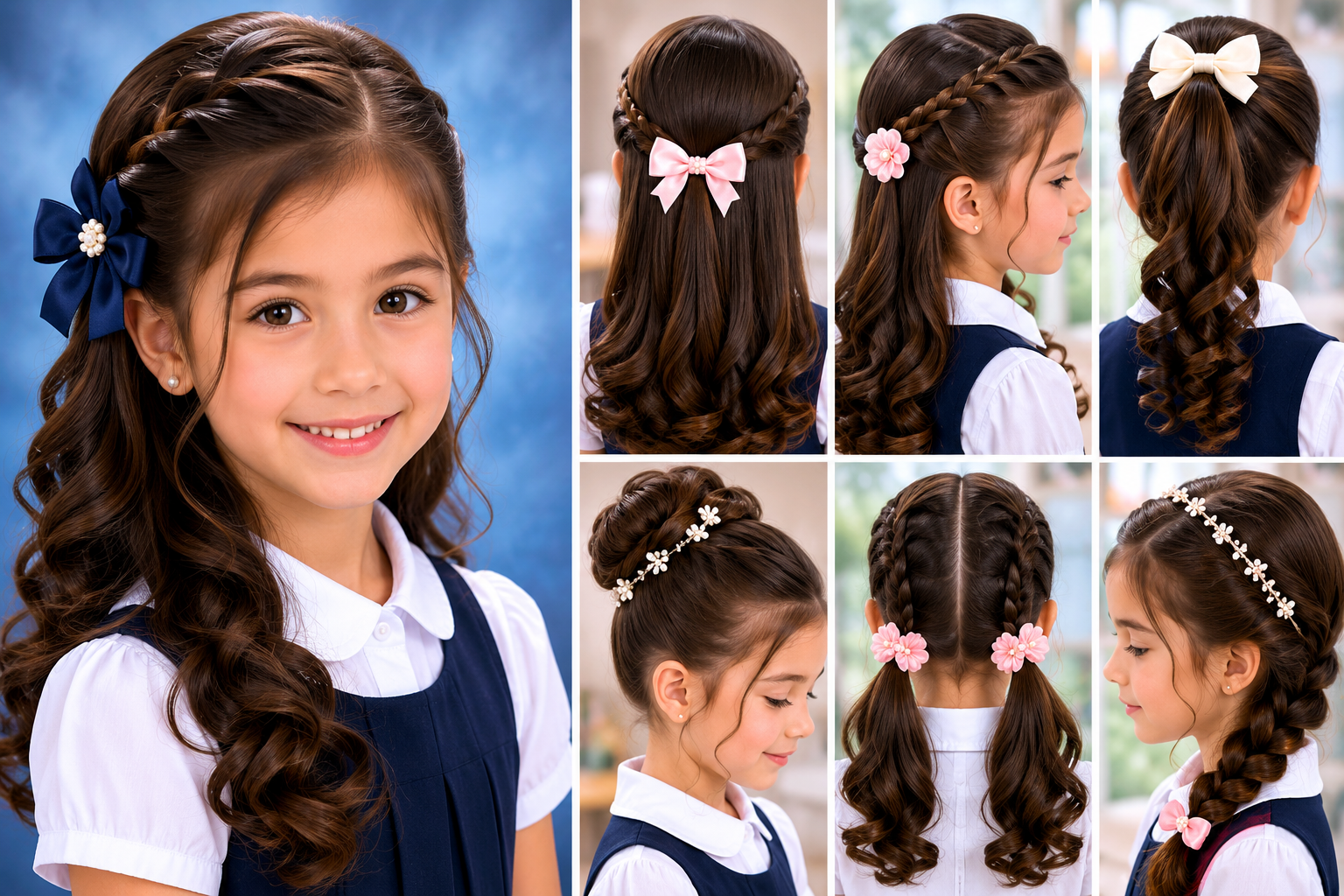
The goal on picture day is a style that looks neat in a photo, holds from morning until the click of the camera (usually mid-morning), and doesn’t require touch-ups. You don’t want elaborate, you want clean and intentional.
- Half-up with a satin bow or clip: classic, photogenic, holds well
- Dutch braid crown: looks formal, stays put all day
- Sleek heart parting with braided accents: trending in 2026, looks stunning in photos
- For natural hair: defined puff with ribbon or pearl pins for extra polish
Wedding & Formal Events:
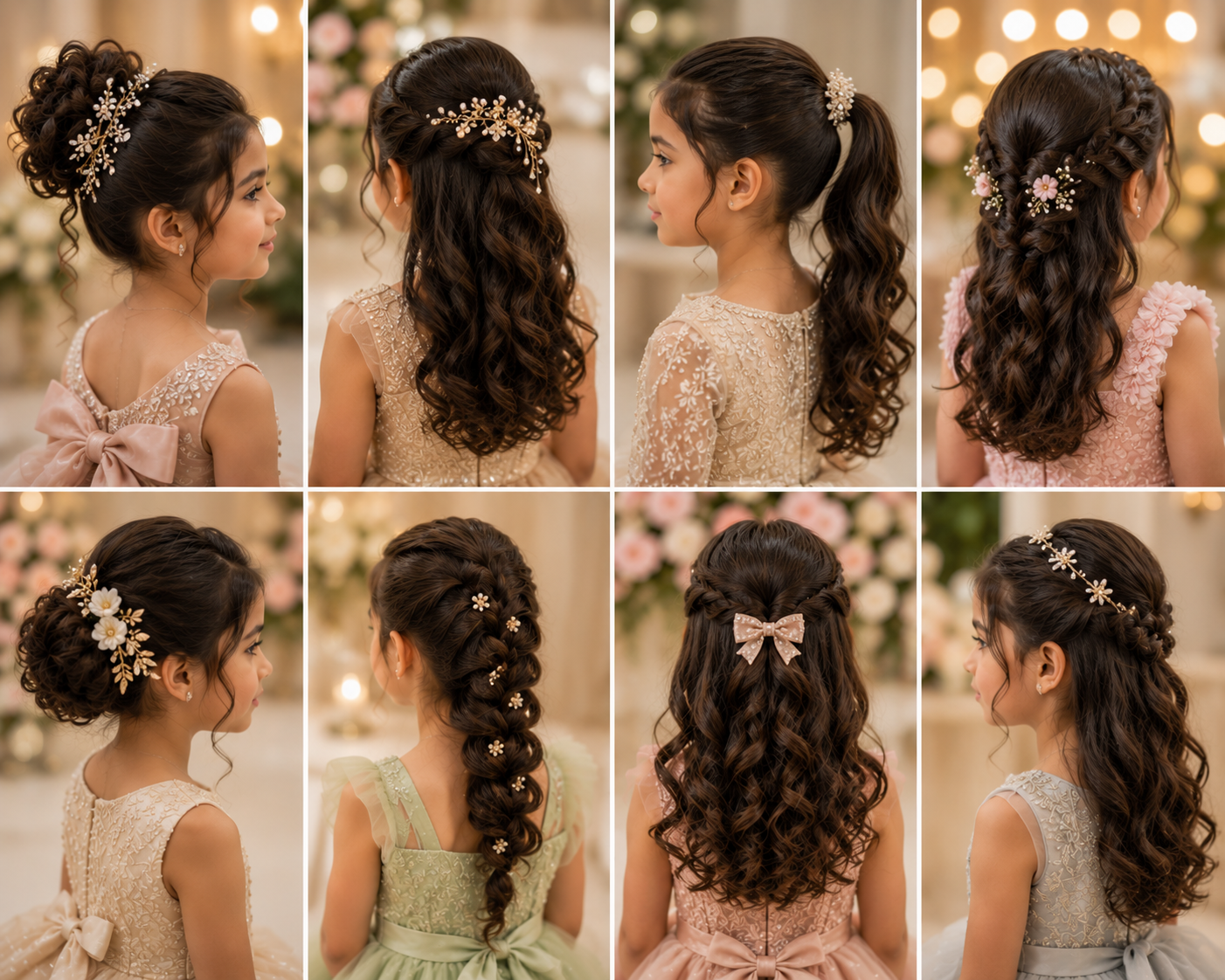
For weddings and formal events, you have a bit more time to invest. A beautiful updo, an intricate braid crown, or elegant pigtails with ribbon these are the moments to go all out.
- Braid crown (halo braid): stunning for flower girls, keeps hair completely out of face
- Low chignon with loose tendrils: timeless, works on all hair types with enough length
- Box braids with gold beads or ribbons: gorgeous for natural hair girls at cultural events
- For Eid: embellished half-up styles with pearl clips or metallic accessories pair beautifully with traditional dress
The Dad-Friendly Emergency Kit
Here’s a section that genuinely exists in no other hairstyle guide: what to do when Dad is doing the school run and has no idea where to start.
Good news there are three styles that require literally zero skill and still look intentional:
- Claw clip bun: gather all hair, twist loosely, clip. Done in 45 seconds.
- Half-up scrunchie: section top half of hair, secure with a soft scrunchie. 30 seconds.
- Two low pigtails: divide hair down the middle, secure each side with a soft elastic. 60 seconds.
Hairstyles for Girls with Fine Hair, Thin Hair, or Glasses
These two groups are almost completely ignored in kids’ hairstyle content which is exactly why parents of fine-haired girls or girls with glasses spend ages searching and finding nothing useful.
What Works for Fine or Thin Hair?
Fine hair lacks grip. Elastics slide out, braids unravel, buns collapse. The solution isn’t giving up on styles, it’s adapting your technique.
- Apply a light volumizing mousse to damp hair before styling it gives fine hair grip
- The stacked bob is the single best haircut for fine-haired girls it creates volume through the graduated layers
- Bubble ponytails work brilliantly on fine hair the puffed sections create the illusion of volume
- For braids, use a light-hold hair serum on sections before braiding they’ll hold for hours
- Avoid very heavy styles (tight top knots, heavy updos) they stress fine hair roots
Hairstyles That Complement Glasses
This is a PAA question that shows up consistently and the answer is more nuanced than most people think. The principle is simple: balance the frames.
Bold frames (thick acetate, colorful) look great with hair pulled back because the glasses become the feature. Delicate frames benefit from loose, flowing styles that add visual interest around the face.
- High ponytail or top knot: draws attention upward, balances strong frames
- Half-up with face-framing pieces: softens any frame style beautifully
- Side braid: adds movement without competing with glasses
- Avoid: overly busy styles around the temples that visually clash with frame details
Step-by-Step: How to Dutch Braid a Little Girl’s Hair
The Dutch braid is genuinely the one skill that transforms your morning routine. Once you can do this, you can do almost everything. It takes most people 3–4 attempts before it clicks then it’s muscle memory forever.
Difficulty: Beginner (after 3 tries). Time: 8–12 minutes until you get fast. Holds all day.
| 1 | Prep the hairLightly mist hair with water or detangling spray. Comb through with a wide-tooth comb from ends to roots. Hair should be smooth but not soaking wet. |
| 2 | Section at the crownUse a rat-tail comb to take a section at the very top of the head — about the size of your palm. Divide it into three equal strands. Hold them spread across your fingers. |
| 3 | Start the pattern: cross UNDERUnlike a French braid where you cross over, in a Dutch braid you cross each outer strand UNDER the middle. Cross right strand under middle, then left strand under (new) middle. |
| 4 | Add hair from each sideBefore crossing each strand under, pick up a small section of loose hair from that side and add it to your strand first. This is what makes the braid ‘travel’ down the head. |
| 5 | Maintain tensionKeep consistent, medium tension — firm enough to hold the braid’s shape, gentle enough not to hurt. Tight is the enemy. The goal is snug, not scalp-pulling. |
| 6 | Continue to the nape of the neckOnce you’ve incorporated all the loose hair from the scalp, continue with a regular three-strand braid (still crossing under) to the end. Secure with a small elastic. |
| 7 | Optional finishGently pull on each loop of the braid with your fingertips to ‘pancake’ it making it wider and fuller. This is the Instagram-level finishing step. |
Kid-Safe Products That Actually Make a Difference
You don’t need 20 products. You need the right 5. Here’s the honest shortlist no fillers, no sponsored recommendations just what consistently makes kids’ hairstyling easier:
- Detangling spray: The single most important product. Apply generously before every brush session. Prevents breakage, reduces pain, makes kids more willing to sit.
- Soft fabric scrunchies (not rubber bands): The single easiest swap that reduces hair breakage at the tie-point by a significant margin. Avoid thin rubber bands on delicate kids’ hair.
- Wide-tooth comb: For detangling always before brushing. Work from ends to roots, not roots to ends.
- Light-hold texturizing spray: For fine hair that needs grip before braiding. A light mist changes everything.
- Rat-tail comb: For making clean, straight parts. Essential for cornrows, Dutch braids, and any sectioned style.
- Satin scrunchies / silk pillowcase: For natural and curly hair reduces friction and breakage overnight.
Frequently Asked Questions
| Which hairstyle is suitable for kids? |
| The most suitable hairstyle for any kid depends on her hair type, length, and how long she’ll sit still. For toddlers: loose pigtails or a soft low ponytail. For school-age girls: Dutch braids, half-up styles, or bubble ponytails. For tweens: claw clip buns, fishtail braids, or space buns. The golden rule is to choose comfort and practicality first, style second. |
| How to style a 2-year-old girl’s hair? |
| Keep it minimal and gentle. At 2, the best approaches are: two soft pigtails secured with fabric baubles, a simple half-up with a small scrunchie, or hair left down with a light detangling spray to keep it neat. Use the widest, softest comb you can find, always on damp (not dry) hair, and keep the whole session under 3 minutes. That’s not a limitation, it’s genuinely all she needs. |
| How to do a 3-year-old girl’s hair? |
| Three-year-olds are marginally more patient than toddlers. You’ve got maybe 4–5 minutes. A French braid is actually achievable at this age if her hair is long enough and you work quickly. Otherwise, a neat side ponytail with a bow, or two low pigtails, look polished and hold all day. Distract with a tablet or favourite show to buy yourself extra time if needed. |
| What are the easiest kids hairstyles for girls with curly hair? |
| For curly hair, the easiest styles are those that work with the curl pattern rather than fighting it. A defined wash-and-go puff takes 2 minutes. Two-strand twists on damp hair take 10–15 minutes and last 3–4 days. Braided pigtails on stretched or blow-dried curls take 8–10 minutes and last a week. Always style on moisturised, damp hair never dry. |
| What hairstyles for girls work for weddings or special occasions? |
| For formal events, the best kids’ hairstyles are: braid crown (halo braid) for flower girls, half-up updo with pins and ribbons, low chignon with loose curls framing the face, or for natural hair girls, box braids with gold beads or ribbons. The key is doing the style the evening before and securing it with quality hairpins never relying on a tight elastic alone for a formal look. |
| How do you detangle a child’s hair without causing pain? |
| The technique matters more than the product. Always start at the ends and work your way up to the roots, never brush from roots to tips, which drags knots through the whole length. Spray detangling spray generously first. Use a wide-tooth comb or a Tangle Teezer brush with flexible bristles. Hold the hair above the section you’re detangling to reduce scalp tension. For very tangled hair, divide into sections and work one at a time. |
| What are good hairstyles for Black girls or kids with 4C hair? |
| The best hairstyles for girls with 4C natural hair prioritize moisture and protection. Cornrows (straight-back or patterned), flat twists, Bantu knots, box braids, and the classic afro puff are all excellent choices. For daily wear, two-strand twists installed on Sunday nights last the full school week. Always style on moisturised hair, use a wide-tooth comb, and protect hair at night with a satin bonnet. |
One Final Thought
The best hairstyle for your daughter isn’t the most elaborate one, or the one with the most Pinterest saves. It’s the one that she feels confident in, that suits her hair, and that you can actually do on a Tuesday morning when everyone’s running five minutes late.
Start with the comparison table, pick one style that matches her hair type, and practise it twice this weekend. By the third time, it’s not styling, it’s just part of your routine.
Her hair is going to look great. You’ve got this.