
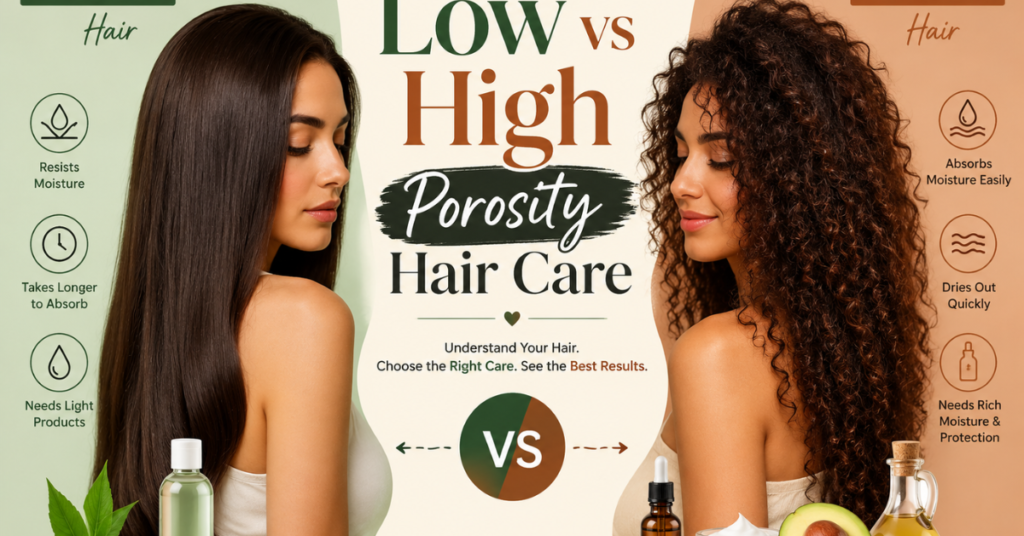
Introduction:
Have you ever wondered why you can spend a fortune on the most highly rated hair products, follow every trending hair care tip you find online, and still end up with hair that feels perpetually dry, limp, greasy, or frizzy? The answer almost always comes down to one deeply misunderstood factor: your hair’s porosity.
Hair porosity is not a term you hear in the average shampoo advertisement, yet it is arguably the single most important characteristic of your hair. More important than the curl pattern. More important than thickness. More important than the brand of conditioner sitting on your bathroom shelf. When you understand your porosity level and build a routine that works with your hair’s natural structure rather than against it, the results are nothing short of transformative.
In this comprehensive guide, we break down everything you need to know about low vs high porosity hair care in 2026 from understanding what porosity actually means, to testing yours at home, to building a step-by-step routine with the right products for each type. Whether you have low porosity, high porosity, medium porosity, or are navigating the unique world of 4C low porosity hair care, this post has you covered.
What Is Hair Porosity?
Hair porosity refers to your hair’s ability to absorb and retain moisture. It is determined entirely by the structure of the outermost layer of the hair shaft, known as the cuticle.
Picture the cuticle as a series of roof shingles layered on top of one another. When those shingles lie flat and close together, moisture has a very hard time getting in but once it does, it stays. When those shingles are raised, open, or even cracked or missing, moisture enters very easily but also escapes just as quickly.
This is the fundamental difference between low and high porosity hair, and it explains why the same product can make one person’s hair look incredibly moisturized and leave another person’s hair feeling like straw.
Porosity is influenced by two main forces:
Genetics: Your natural hair structure including how tightly or loosely your cuticles are packed is largely inherited. For example, many people with straight, fine, or Asian hair types naturally have low porosity. Those with coily, tightly curled, or 4C hair textures often have higher porosity due to the twists and bends in the hair shaft creating natural weak points in the cuticle layer.
Environmental and chemical damage: Over time, external factors including UV exposure, heat styling, bleaching, perming, and chemical relaxers can lift and damage the cuticle layer, pushing hair from low toward higher porosity regardless of its natural starting point.
The Three Porosity Types:
Low Porosity Hair Care: Understanding the Resistant Type
Low porosity hair has cuticles that lie extremely flat and are tightly compacted together. This creates a near-impenetrable barrier on the surface of the hair shaft.
Characteristics of low porosity hair:
- Water beads up on the surface of the hair rather than absorbing immediately
- Products tend to sit on top of the hair rather than penetrating the strand, causing buildup
- Hair takes a very long time to become fully saturated when wet
- Hair also takes a long time to air-dry completely
- Naturally appears shiny because flat cuticles reflect light well
- Susceptible to product buildup, especially from heavy butters and oils
The core challenge: The problem with low porosity hair is not that it is unhealthy in fact, it is often naturally quite strong and shiny. The challenge is getting moisture and nutrients past that tightly sealed cuticle layer in the first place. Without the right techniques, products simply pile up on the outside of the hair without ever nourishing the cortex beneath.
This type is extremely common among people with fine or straight hair, but it also appears across all hair textures, including wavy, curly, and coily hair types.
High Porosity Hair Care:
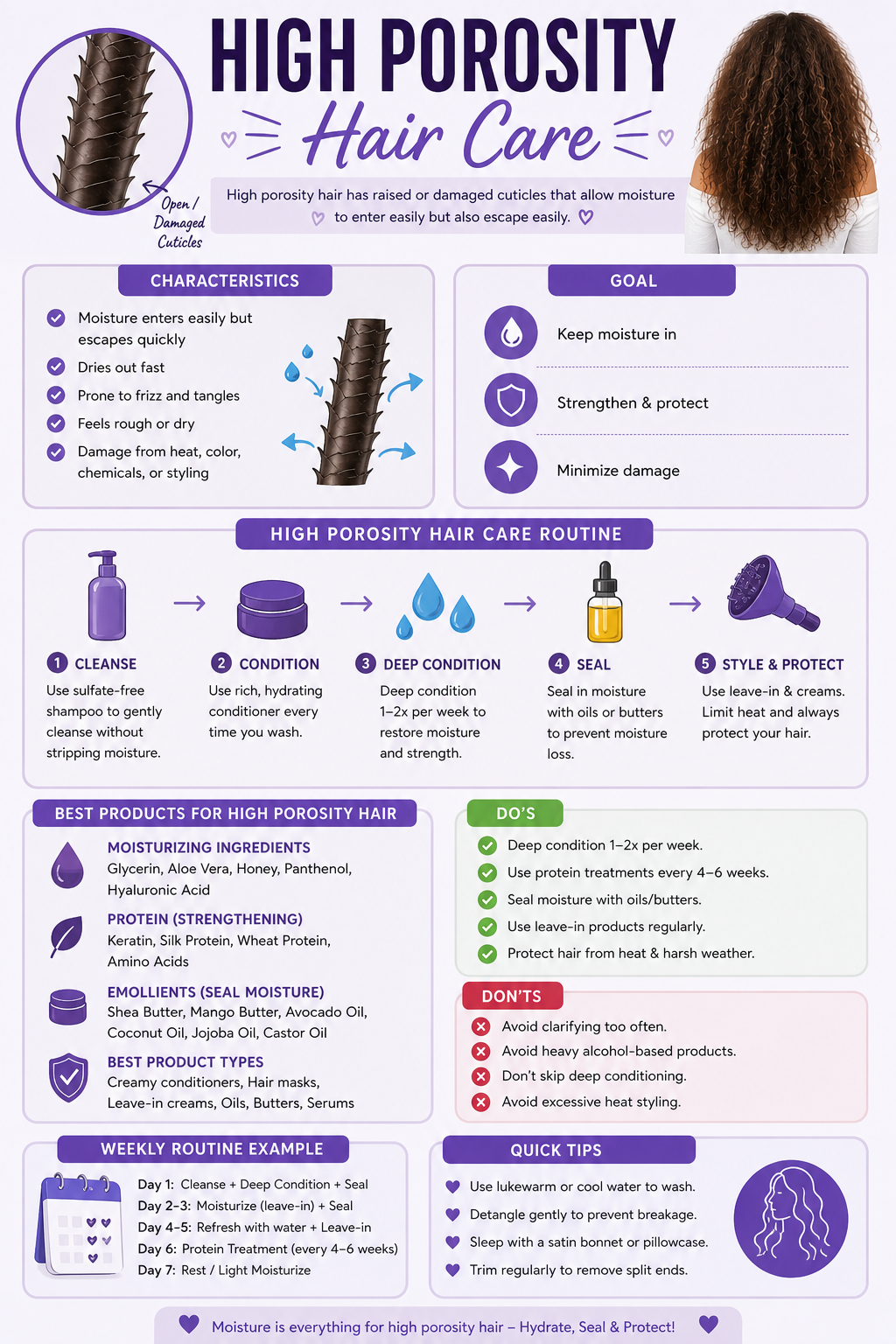
High porosity hair sits at the opposite end of the spectrum. Its cuticles are raised, open, cracked, or have gaps meaning moisture rushes in easily but escapes just as quickly.
Characteristics of high porosity hair:
- Hair absorbs water and products almost instantly
- Despite rapid absorption, hair feels dry again within hours (or even minutes)
- Prone to frizz, especially in humid environments, because the open cuticles absorb moisture from the air
- Tangles easily because raised cuticles catch on one another
- Prone to breakage, split ends, and general fragility
- Air dries very quickly after washing
The core challenge: High porosity hair is like a bucket with holes in the bottom. You can pour in all the water and conditioner you want, but if the cuticle cannot hold it in place, the hair will perpetually feel parched. High porosity hair needs products and techniques that help seal the cuticle and lock moisture inside.
High porosity hair can be entirely natural (especially in highly coiled or chemically processed hair types) or it can be the result of cumulative damage from heat, color treatments, or harsh cleansers.
Medium Porosity Hair Care:
Medium porosity hair is considered the ideal. Its cuticles are slightly raised just enough to allow moisture to enter freely while remaining closed enough to hold that moisture inside for a reasonable amount of time.
Characteristics of medium porosity hair:
- Hair absorbs moisture and products with ease
- Holds styles well and responds predictably to both heat and chemical treatments
- Looks naturally healthy with good shine and elasticity
- Can tolerate a wide variety of products without reacting negatively
- Gets wet and dries within a normal, moderate timeframe
The core challenge: Medium porosity hair is relatively low-maintenance, but it is not invincible. Without proper protection, heat styling and chemical processing can gradually push it toward high porosity. The goal for medium porosity hair is maintenance and prevention keeping the cuticle in its naturally balanced state for as long as possible.
How to Test Your Hair Porosity at Home
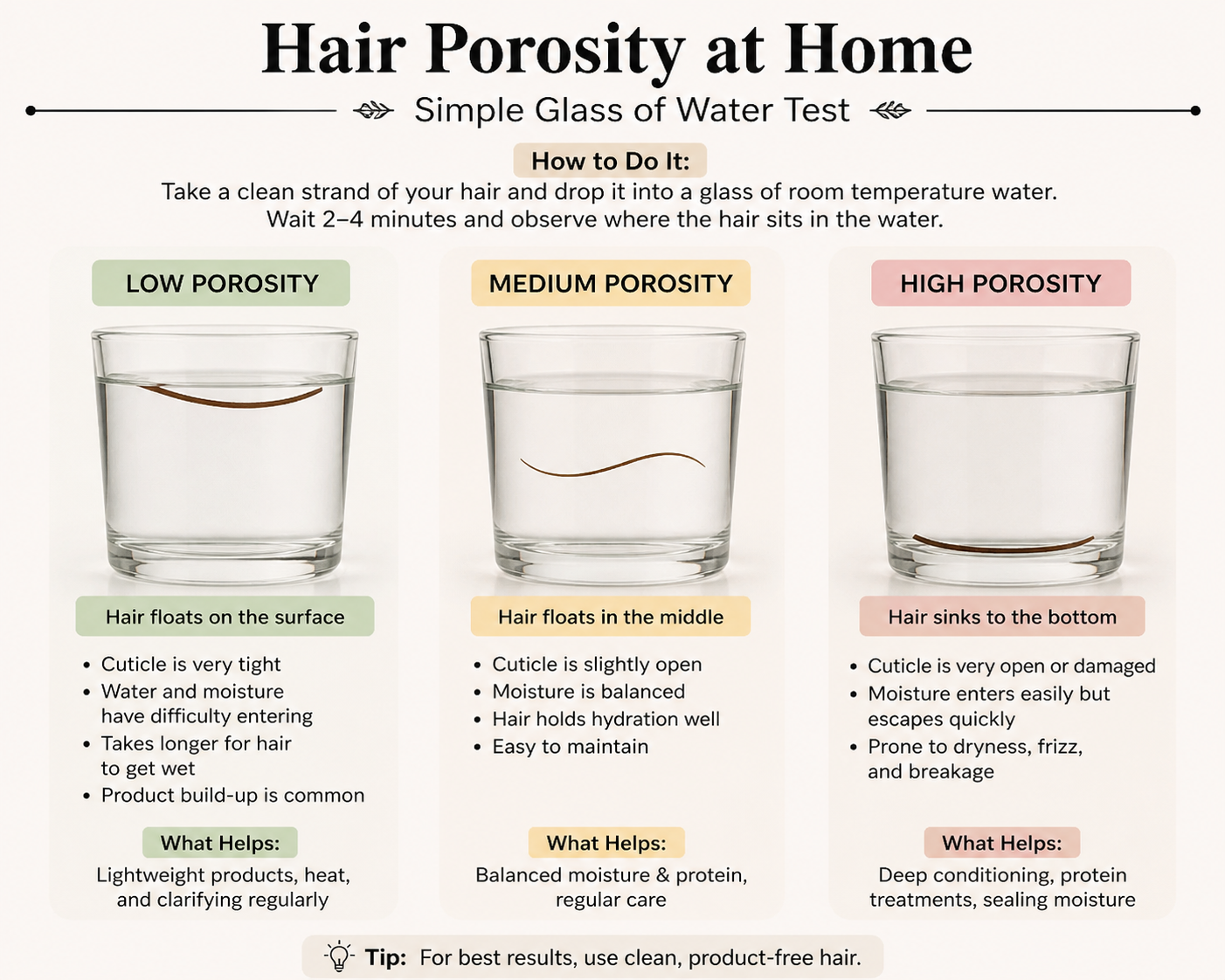
Before changing a single thing about your routine, you need to know which category your hair falls into. Here are three reliable at-home methods.
The Float Test
This is the most widely used porosity test. Take a clean, dry strand or two of hair free of any product buildup and drop it into a glass of room-temperature water. Let it sit undisturbed for two to four minutes, then observe:
- Floats on top Low porosity (tight cuticles resist water)
- Floats in the middle / sinks slowly Medium porosity
- Sinks quickly to the bottom High porosity (open cuticles absorb water rapidly)
Important note: Make sure your hair is clean before the test. Hair coated in oils, silicones, or styling products will not give accurate results.
The Slip-and-Slide Test
Take a single strand of hair between your thumb and index finger and slide your fingers slowly from the tip up toward the scalp. Pay attention to what you feel:
- Smooth, almost no texture Low porosity (flat cuticles)
- Slight texture Medium porosity
- Bumpy, rough, or catches on your fingers High porosity (raised cuticles)
The Observation Test
Simply pay attention to how your hair behaves day to day:
- Does it take forever to get wet in the shower and equally long to dry?
- Low porosity
- Does it spring back to life quickly with moisture but also lose that moisture fast?
- High porosity
- Is your hair generally cooperative and balanced in how it responds to products?
- Medium porosity
Low Porosity Hair Care Routine:
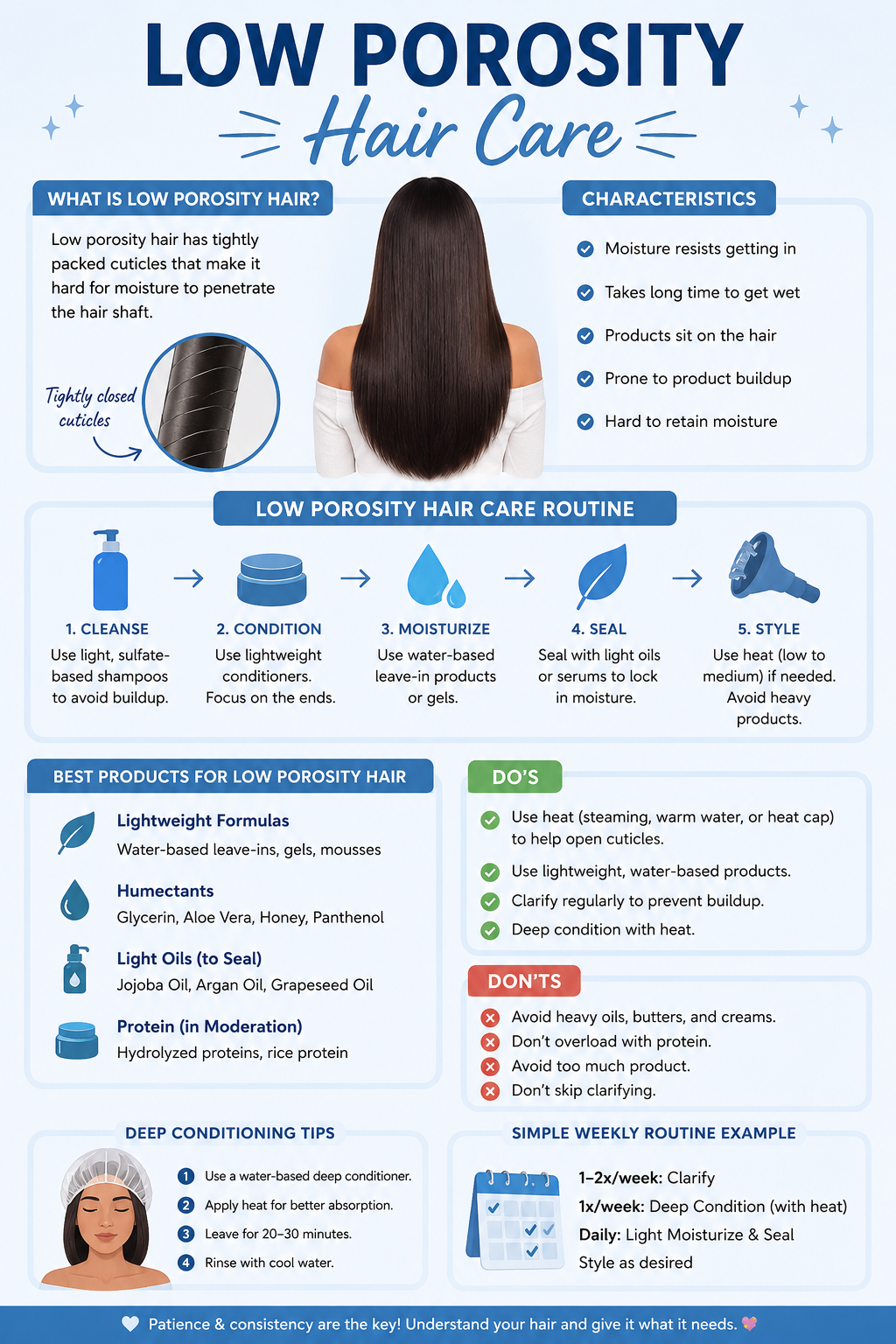
Building an effective low porosity hair care routine requires understanding one central principle: heat is your best friend. Heat gently lifts the cuticle, allowing moisture and nutrients to actually penetrate the hair shaft rather than sitting on the surface.
Step 1: Clarifying Shampoo
Because low porosity hair is so prone to product buildup, start with a clarifying or lightweight sulfate-free shampoo. This removes the residue sitting on the surface and gives your hair a clean slate. Avoid heavy, creamy shampoos they add to the buildup problem.
Step 2: Apply Conditioner with Heat
This is the single most important step in a low porosity hair care routine. Apply a lightweight, humectant-rich conditioner (look for glycerin, aloe vera, or honey in the ingredients) and then:
- Cover your hair with a plastic shower cap or processing cap
- Sit under a hooded dryer for 15–30 minutes, or wrap a warm towel around your head
- Alternatively, steam your hair using a handheld steamer
The gentle heat lifts the cuticle just enough for the conditioner to penetrate and deposit moisture where it is actually needed.
Step 3: Rinse with Warm (Not Cold) Water
Many popular hair care guides recommend a cold water rinse to seal the cuticle. For low porosity hair, this is counterproductive. Cold water tightens the already-tight cuticle even further, making it harder for the moisture you just worked to get in to stay accessible. Rinse with warm water instead.
Step 4: Apply a Lightweight Leave-In Conditioner
After rinsing, apply a water-based, lightweight leave-in conditioner. Avoid heavy butters, thick creams, and oil-first products; these will simply sit on top of the cuticle and contribute to more buildup. Products labeled “water-based” or those that list water or aloe vera as the first ingredient are ideal.
Step 5: Light Sealing Oil (Optional)
If you choose to use an oil, reach for lightweight options like argan oil, sweet almond oil, or jojoba oil. Apply sparingly just enough to lightly seal the moisture in without smothering the hair.
Step 6: Style and Air-Dry or Diffuse
Style as desired. Because low porosity hair retains moisture well once it has absorbed it, you do not need to reapply moisture constantly. Avoid heavy gels or waxes, which are notorious for causing buildup on this hair type.
Low Porosity Hair Care Products:
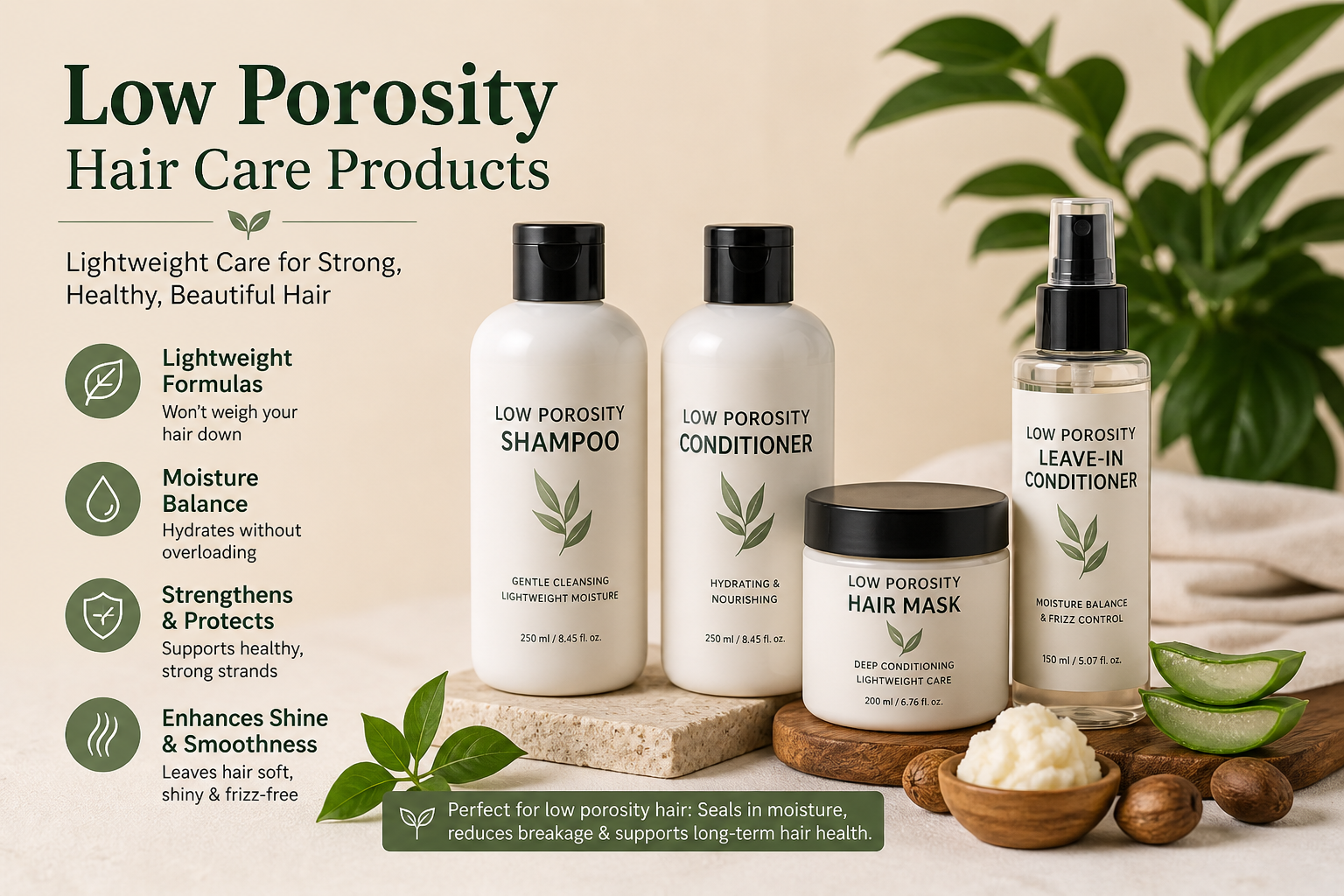
Ingredients to Seek Out for Low Porosity Hair:
- Humectants: Glycerin, aloe vera, honey, panthenol these attract water from the air into the hair shaft
- Light protein: Hydrolyzed protein in moderate amounts (avoid protein overload)
- Lightweight oils: Argan, jojoba, sweet almond, grapeseed
Ingredients to Avoid for Low Porosity Hair:
- Heavy butters: Shea butter, coconut oil (as a sealant), castor oil these are too heavy and create buildup on low porosity strands
- Silicones: These coat the hair without penetrating and are difficult to remove without clarifying
- Very thick creams: Products with a dense, heavy consistency rarely penetrate the cuticle effectively
High Porosity Hair Care Routine:
The high porosity hair care routine operates on the opposite philosophy: rather than working to open the cuticle, the goal is to nourish the hair deeply and then seal that moisture in.
Step 1: Gentle, Moisturizing Shampoo
High porosity hair is already fragile and prone to damage, so choose a sulfate-free, moisturizing shampoo that cleanses without stripping. Harsh, drying shampoos will further roughen the already-damaged cuticle layer.
Step 2: Deep Conditioning Treatment
Deep conditioning is non-negotiable for high porosity hair. Use a rich, penetrating deep conditioner ideally one containing protein (keratin, hydrolyzed silk, or quinoa) combined with intense moisturizers (shea butter, avocado, or ceramides). The protein helps temporarily fill in the gaps in the damaged cuticle, while the moisturizers replenish what the hair has been losing.
Apply generously, cover with a plastic cap, and leave on for 20–30 minutes. Unlike low porosity hair, high porosity hair does not need additional heat to absorb products; it absorbs things very readily on its own.
Step 3: Cold Water Rinse
After deep conditioning, rinse with the coldest water you can tolerate. This helps temporarily flatten the raised cuticle layers, trapping the moisture inside and reducing frizz.
Step 4: Apply a Protein-Rich Leave-In Conditioner
Choose a leave-in conditioner that balances moisture and protein. High porosity hair benefits enormously from regular protein treatments because they temporarily patch the gaps in the cuticle. Look for products with hydrolyzed proteins, ceramides, or keratin.
Step 5: Layer Your Products (The LOC or LCO Method)
High porosity hair does best when moisture is layered and sealed. Consider the LOC method (Liquid → Oil → Cream) or the LCO method (Liquid → Cream → Oil):
- Liquid: A water-based leave-in conditioner to hydrate
- Oil: A medium-to-heavy oil like castor oil, olive oil, or avocado oil to begin sealing
- Cream: A rich butter or cream to create a protective barrier
Unlike low porosity hair, high porosity strands can handle and actually need heavier products to lock in moisture.
Step 6: Anti-Humidity or Sealing Products
In humid climates, high porosity hair tends to frizz dramatically because the open cuticles pull moisture from the air uncontrollably. A light anti-frizz serum or sealing butter applied as the last step can help significantly.
4C Low Porosity Hair Care:
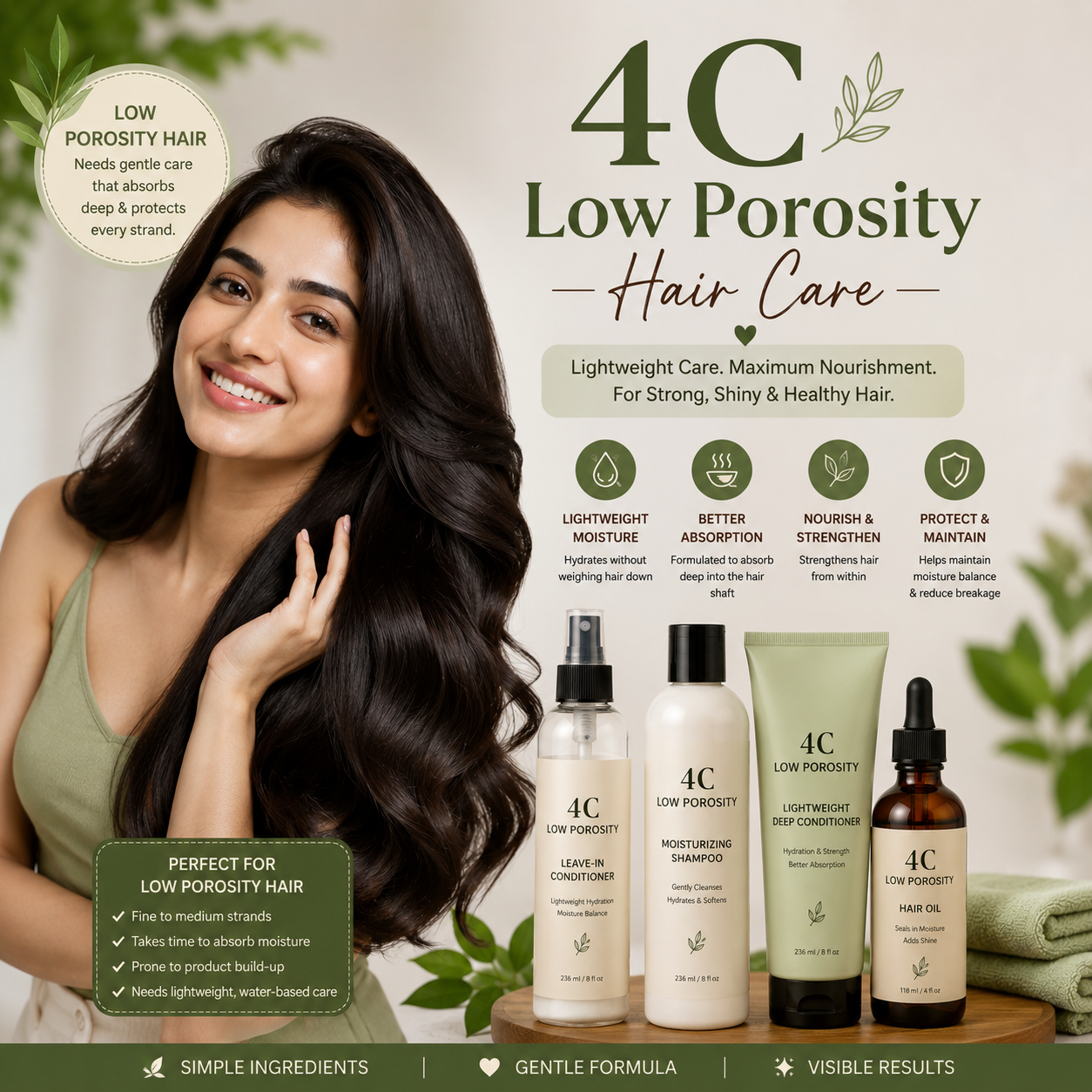
Among all hair textures and porosity combinations, 4C low porosity hair care is perhaps the most frequently misunderstood. Type 4C hair has the tightest curl pattern of any hair type, with tiny, densely packed coils with very sharp angles in the curl. This structure already makes moisture penetration more challenging, and when you add low porosity to the mix, you have a hair type that resists moisture at every possible level.
People with 4C low porosity hair often report that their hair looks dry no matter what they do, that products just sit on top, and that their hair takes an extraordinarily long time to dry. These are all hallmarks of the combination.
Key adjustments for 4C low porosity hair care:
- Steam treatments are essential. A hair steamer is not a luxury for this hair type, it is practically a necessity. Steam opens the cuticle gently and thoroughly, allowing moisture to reach the cortex in a way that even a shower cap and warm towel cannot fully replicate.
- Avoid the “grease and go” method. Heavy products like petroleum-based greases and thick butters are particularly problematic for 4C low porosity strands. They create a thick coating that seals out moisture entirely.
- Pre-poo with gentle heat. Before shampooing, apply a lightweight oil or conditioner to dry hair, cover with a processing cap, and let gentle heat work for 20–30 minutes. This softens the hair and makes detangling significantly easier.
- Wash in sections. Washing 4C low porosity hair in four to eight sections helps ensure that water and product actually saturate the hair instead of running off the surface.
- Use the greenhouse effect. Spritz the hair lightly with water or a diluted leave-in conditioner, apply a lightweight oil, and cover with a plastic cap overnight. The body heat generated while sleeping creates a mini greenhouse effect that gradually drives moisture into the tightly sealed cuticle.
High Porosity Hair Treatment at Home:
If you have high porosity hair and prefer natural treatments, several at-home remedies have shown real results for temporarily smoothing and strengthening the cuticle.
Apple cider vinegar (ACV) rinse: Dilute one to two tablespoons of ACV in one cup of water and pour it through your hair after conditioning. ACV is mildly acidic, which helps flatten the raised cuticle layer temporarily. Rinse out after a few minutes.
Protein treatment with eggs: Eggs are rich in protein and can temporarily fill in gaps in a damaged cuticle. Mix two eggs with a tablespoon of olive oil and a tablespoon of honey, apply to damp hair, cover with a cap for 20–30 minutes, then rinse with cool water. Do not overdo protein treatments once every two to four weeks is appropriate for most high porosity hair types.
Rice water rinse: Fermented rice water is rich in inositol, a carbohydrate that can penetrate the hair shaft and help repair damage from the inside. Soak white rice in water for 24–48 hours, strain, and use the resulting liquid as a final rinse or leave-in treatment.
Avocado and honey mask: Avocado is loaded with fatty acids and vitamins that deeply moisturize and can temporarily help smooth the cuticle. Mash half an avocado with two tablespoons of honey, apply to clean, damp hair, cover, and leave for 30 minutes before rinsing.
Low to Medium Porosity Hair:
Not everyone falls neatly into one category. Many people have low to medium porosity hair that sits in the transitional zone. These individuals will notice that their hair does eventually absorb moisture, just more slowly than medium porosity hair, and that it retains moisture fairly well once absorbed.
For low to medium porosity hair, the routine sits comfortably between the two extremes. Use steam or warm water occasionally but not every wash day. Lightweight leave-in conditioners work better than heavy creams, but a small amount of a medium-weight butter or oil is not necessarily problematic. Regular deep conditioning without heat (versus the mandatory heat of true low porosity hair) may be sufficient. Pay attention to how your hair responds and adjust accordingly.
High vs Low Porosity Hair:
| Factor | Low Porosity Hair | High Porosity Hair |
| Cuticle state | Tightly sealed, flat | Raised, open, or damaged |
| Absorb water? | Slowly | Instantly |
| Retains moisture? | Very well | Poorly |
| Drying time | Long | Short |
| Prone to | Buildup | Frizz, breakage, dryness |
| Best products | Lightweight, humectant-rich | Rich, protein-balanced, heavy sealants |
| Heat during conditioning? | Yes essential | No not necessary |
| Rinse temperature | Warm | Cold |
| Oil weight | Light (argan, jojoba) | Heavy (castor, olive, avocado) |
Is Low Porosity Hair Good?
One of the most commonly searched questions in this space is simply: is low porosity hair good? The answer is a definitive yes with the right routine.
Low porosity hair is naturally strong, naturally shiny, and naturally resistant to environmental damage. Because the cuticle is so tightly sealed, it is much harder for the hair to lose moisture once you have successfully introduced it. Low porosity hair is also generally less prone to breakage and split ends compared to high porosity hair.
The challenge with low porosity hair is not that it is damaged or weak, quite the opposite. The challenge is simply that it requires a specific, targeted approach that most generic hair care advice does not account for. Once you understand how to get moisture past that sealed cuticle (heat, humectants, lightweight products), your low porosity hair will reward you with incredible shine, strength, and manageability.
Medium Porosity Hair Products and Maintenance:
If you are lucky enough to have medium porosity hair, your product and routine options are the most flexible of any porosity type. Your hair can tolerate a wide range of ingredients and formulations without reacting badly. However, that flexibility can also lead to complacency: using too much heat or too many harsh chemicals over time will inevitably shift your hair toward high porosity.
For medium porosity hair, focus on:
- Balanced moisturizers: Neither too lightweight nor too heavy
- Occasional protein treatments: Every four to six weeks to maintain strength
- Heat protection: Non-negotiable every time you use heat tools
- Low-manipulation styles: To minimize mechanical damage that opens the cuticle over time
- pH-balanced products: Products with a pH between 4.5 and 5.5 help keep the cuticle in its naturally balanced state
Building Your Personalized Porosity-Based Hair Care Routine:
Regardless of whether you have low, medium, or high porosity hair, a few universal principles apply:
Consistency is everything. The results of a porosity-appropriate routine do not appear overnight. Give any new routine at least four to eight weeks before evaluating its effectiveness.
Listen to your hair. The signs your hair gives you how it feels after washing, how quickly it dries, whether it tangles easily, how it responds to protein are more valuable than any product label.
Protein-moisture balance matters for everyone. Both low and high porosity hair need a balance of protein and moisture, just in different ratios and at different frequencies. Too much protein makes hair stiff and brittle; too much moisture without protein leads to weak, mushy strands.
Rotate your clarifying wash. Even high porosity hair benefits from occasional clarifying to remove buildup that can mask product effectiveness.
Protect your hair at night. Sleeping on a satin or silk pillowcase, or wrapping hair in a satin bonnet or scarf, significantly reduces friction-based cuticle damage regardless of porosity type.
Frequently Asked Questions
Q: What are the best high porosity hair products to look for in 2026?
A: Look for deep conditioners and leave-ins containing ceramides, keratin, hydrolyzed proteins, and rich moisturizers like shea butter and avocado. For sealing, heavy oils like castor and olive oil work best. Avoid products with lots of drying alcohols.
Q: What are the best low porosity hair products?
A: Opt for lightweight, water-based products with humectants like glycerin, aloe vera, and panthenol. Clarifying shampoos used regularly prevent buildup. Lightweight oils like argan and jojoba are ideal for sealing.
Q: What is medium porosity hair, and how do I know if I have it?
A: Medium porosity hair sits between the two extremes. It absorbs moisture easily and retains it reasonably well. Your hair likely takes a moderate amount of time to get fully wet and fully dry, holds styles reliably, and responds well to most products. The float test strand usually settles in the middle of the glass of water.
Q: What is the best high porosity hair treatment at home?
A: An apple cider vinegar rinse, a rice water treatment, or a DIY protein mask with eggs and honey are highly effective at home. Regular deep conditioning with protein is the cornerstone of high porosity hair treatment at home.
Q: Is low porosity hair good or bad?
A: Low porosity hair is absolutely not a bad thing. It is naturally strong, shiny, and moisture-retaining once hydrated. It simply requires a targeted approach primarily heat during conditioning and lightweight, humectant-rich products to thrive.
Q: How do you tell the difference between high vs low porosity hair?
A: The simplest method is the float test (low porosity floats, high porosity sinks). You can also pay attention to drying time (long = low porosity, short = high porosity), how quickly products absorb, and whether hair tends to feel dry and frizzy (high porosity) or product-coated and slow to wet (low porosity).
Q: What are the best medium porosity hair products?
A: Medium porosity hair can handle a wider range of products than the other types. Balanced moisturizing shampoos, regular conditioners, and occasional protein treatments work well. Focus on heat protection products if you use any heat tools.
Q: I have low to medium porosity hair — what should I do?
A: Start with the low porosity approach lightweight products and occasional steam or heat during conditioning and adjust from there. If your hair responds well to slightly heavier products or does not require heat every single wash, you likely sit closer to the medium end. Experiment with both approaches and observe how your hair responds.
Q: How can I tell if my 4C hair is low or high porosity?
A: Use the float test with clean, product-free strands. Because 4C hair has a very tight curl pattern and can shrink significantly, it helps to stretch a strand gently before placing it in the water. Additionally, observe how quickly your hair dries after washing 4C low porosity hair takes much longer to dry than 4C high porosity hair.
Q: Can porosity change over time?
A: Yes. Heat styling, chemical treatments, and environmental damage can all raise the cuticle over time, gradually increasing porosity. Protective styles, heat-free periods, and consistent deep conditioning can help slow this process and maintain healthier porosity levels.
Conclusion:
Understanding the difference between low vs high porosity hair care is not just a hair care tip, it is the foundation upon which every other product choice, styling decision, and treatment should be built. Once you know your porosity type, the frustration of products that do not work disappears, replaced by a routine that consistently delivers the results your hair has always been capable of.
Whether you are managing a strict low porosity hair care routine with steam treatments and lightweight leave-ins, rebuilding high porosity strands with protein-rich deep conditioners and heavy sealants, navigating the nuances of 4C low porosity hair care, or simply maintaining the naturally balanced state of medium porosity hair you now have a complete roadmap to follow.
Start with the float test today. Build your routine around what your hair actually needs. And give it the time it deserves. Healthy, thriving hair is not a lucky accident, it is the result of understanding and working with your hair’s unique biology.